Source: TWIKE press release dated May 10, 2023, updated on November 6, 2023
TWIKE also breaks new ground with its steering system, offering safe and sporty driving pleasure with ergonomic side-stick steering. And the first test drives with the driver test vehicle confirm all expectations.
A bicycle has handlebars, a car is steered by the driver using a steering wheel – at first glance, this statement seems irrefutable. More than two centuries of automotive history suggest that a classic steering wheel is the most sophisticated and optimal technology for steering a car in practice. But what if this car no longer corresponds to the widespread image of a car in many other respects? Shouldn’t its steering system also be questioned? Ever since the first version of the three-wheeled electric vehicle, with its combination of an electric motor and pedal assistance powered by muscle power, the developers of the TWIKE answered this fundamental question with “yes.”
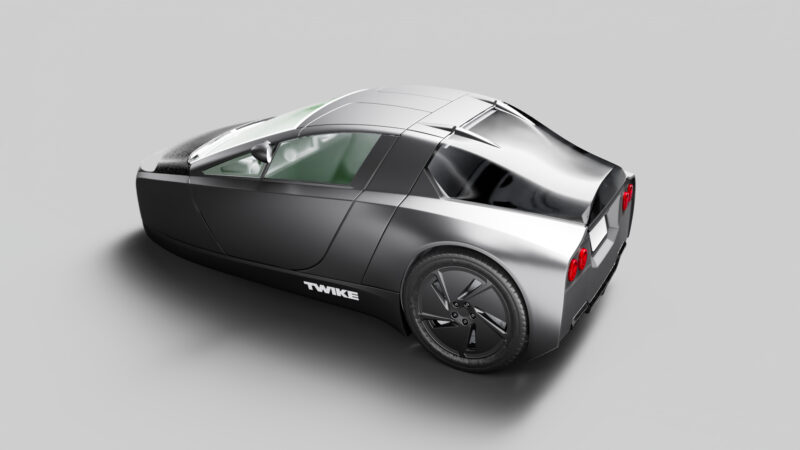
Neither the handlebars familiar from bicycles nor the steering wheel proven in automobiles were suitable for the design, which in a sense combines both worlds, the bicycle and the electric car. In view of the three-wheeled design and the characteristic seating position of the driver, the use of a control lever proved to be the most suitable option. Like all components, this steering principle has been repeatedly adapted and optimized throughout the TWIKE model history. With the steering of the TWIKE 5, the extraordinary manufacturer from Rosenthal presents another milestone in the development of this unique vehicle.
In the first three model series of the TWIKE, the developers opted for single-lever steering. The “joystick” proved to be the optimal solution here, enabling safe and reliable control after a certain amount of familiarization. Where a classic steering wheel would have been unsuitable due to the pedal movement, the joystick is not only an ergonomic alternative that is conducive to the lightweight construction principle, but also offers owners additional driving pleasure to this day.
“Nevertheless, we didn’t want to rest on our laurels with the steering system and adopt a ‘never change a running system’ approach,” explains Martin Möscheid, Managing Director of TWIKE GmbH. “If we had thought that way in the past, we would never have got to where we are today with the TWIKE 5.”
The TWIKE 4, the pure prototype that preceded the TWIKE 5 on its way to series production, was the first to question the concept of single-lever control. Not least due to the performance gains of the Twike 5 over the TWIKE 3, aspects such as quick learnability of the functionality and maximum steering precision in all driving situations are becoming even more important. The developers also wanted to make the transition from a classic car with steering wheel control easier by allowing basic movement patterns to be adopted. The TWIKE 5 presents the solution to these requirements and wishes with a completely newly developed two-lever principle, the side-stick steering.

Two interconnected steering levers mechanically control the steering front axle in the TWIKE 5 using this steering principle. Even though the connection between the levers allows for one-handed steering, the principle is particularly impressive when operated with both hands. In practice, the steering process follows a movement pattern that is recognizably similar to that of a classic steering wheel, making it very intuitive to get used to. The driver pulls or, more accurately, pushes the levers in the desired direction of travel. This form of “classic” steering also supports a stable seating position, which pays off especially during sporty driving maneuvers, but also on uneven ground and in dangerous situations.
Technically, the optimized steering system relies on components from large-scale automotive production, ensuring proven quality and safety. In addition, both levers offer easy and comfortable access to all important functions in two-handed operation: acceleration, cruise control, turn signals, high/low beam, windshield washer system, and control of the digital instrument cluster functions. With interchangeable handlebar grip surfaces and standard handlebar heating underneath, the TWIKE cockpit can be customized to suit individual preferences.
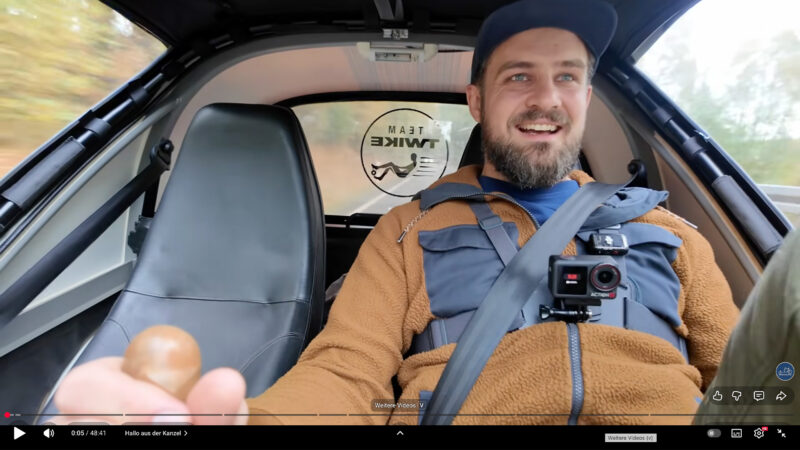
“We are convinced that the optimized steering system in the TWIKE 5 will further improve the connection between the driver and the vehicle, offering even greater safety and additional driving comfort,” emphasizes Möscheid, adding, “the first test drives with the recently commissioned driver test vehicle already impressively demonstrate this.” The adjustment options planned for the test phase still leave room for final optimization.