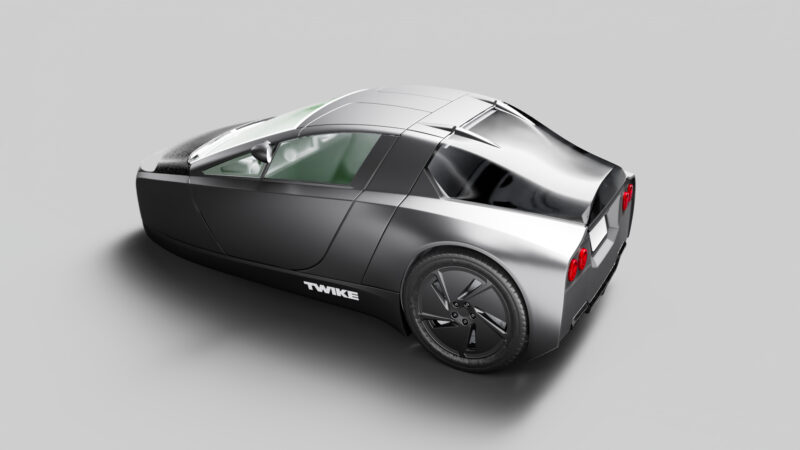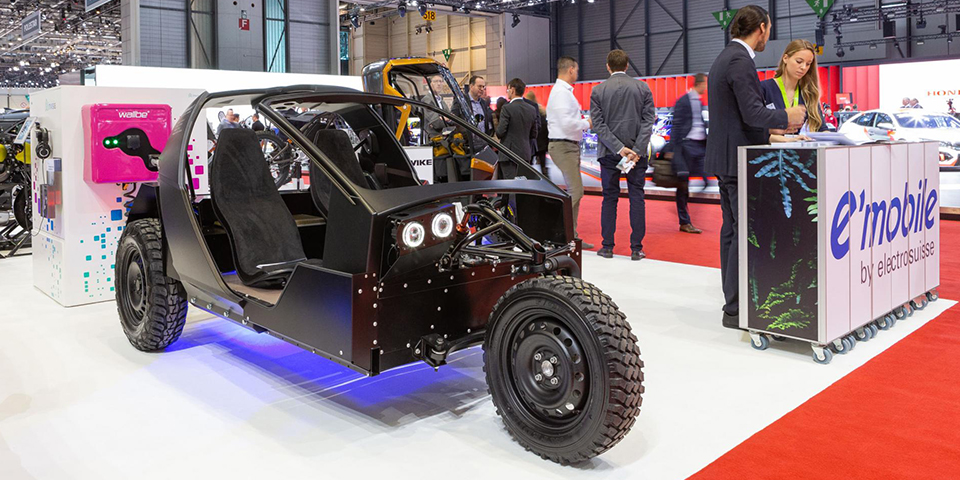
At the Geneva Motor Show 2019, Fine Mobile GmbH presented the successor to the Twike 3, which has sold over 1,000 units, the Twike 5. Yes, because the name Twike is made up of Twin and Bike, which in turn refers to the original idea behind this vehicle. The tricycle, which was originally conceived in Switzerland and won first prize in a university design competition in Vancouver at the 1986 Expo, is essentially a covered tandem with two seats installed side by side. But back to the future.
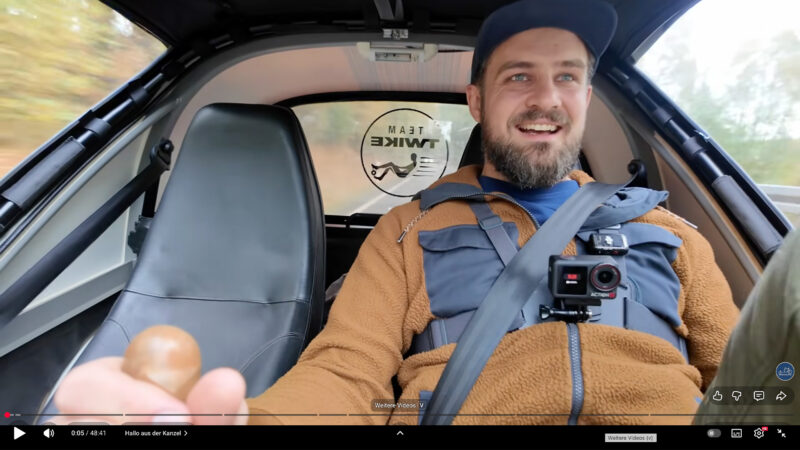
The Twike 5, which can be driven by A1, A and B licence holders, is said to be capable of speeds of up to 200 kilometres per hour and costs from 39,000 euros. Of course, such a speed cannot be realised by pedalling alone. The main drive is provided by a 45 kilowatt synchronous motor with up to 250 Newton metres of power. The two occupants can contribute up to 20 per cent – at city speeds – by pedalling, whereby they can pedal up to 300 watts. However, the passenger can only pedal if the owner has ticked an additional box when ordering. This is because the co-pilot’s footwell is empty in the basic version. Important for the front passenger: they can, but do not have to, use the pedals, even if they are available.
Twike 5: Up to 200 km/h with pedalling
After 5,000 kilometers , the V-max is lifted – perhaps
When ordering, you must also specify the battery size: 15, 20, 25 or 30 kilowatt hours. The maximum achievable top speed of the Twike 5 also depends on the size of the batteries. Between 120 and 200 km/h are possible. But not right from the start. The V-max can only be raised after 5,000 kilometres have been driven. Until then, you will have to make do with 130 kilometres per hour. Furthermore, the speed limit will only be cancelled if the manufacturer deems the owner of the vehicle fit to drive. It sounds strange, but it’s true.
Before the order itself is placed , however, there is still the production. This is a tricky issue, because although 507 orders have been received for the Twike 5 , which is limited to 500 units , it is not yet 100 per cent certain that it will ever be built. In addition to the target of 200 incoming orders , which was reached quite quickly , there is another prerequisite: two million euros. As of today (21 March 2019), the sum collected via crowdfunding called Twike Community Funding is just under 1.1 million euros. However, this should be completed by the summer, according to Fine Mobile. The difference to conventional crowdfunding is that the project is not supported by donations, but by an interest-bearing loan. The donor determines the amount of the loan themselves . He invests the money as an interest-bearing down payment on a Twike 5.
Steering wheel? No thanks
As soon as you look at the chunky car tyres, it is clear that this 495-kilogram vehicle (320 kilograms without battery) has little in common with a bicycle tricycle. The frame is an aluminium space frame. The initially conceived telescopic fork has given way to a double trailing arm swing arm with wheel bearing flange for classic car wheel rims, the doors swing open upwards and a steering wheel, in whatever form, is sought in vain. To ensure that the 3.04 metre long, 1.55 metre wide and 1.26 metre high two-seater still turns corners, a double-lever steering system with bump-steer compensation is used. In German: two levers to the right and left of the driver’s seat, which can be upholstered in Alcantara on request. Operation is extremely simple. If the left hand pulls the lever backwards, the Twike 5 moves to the left. If the right hand pulls the lever, the Twike 5 moves to the right. The speed can also be changed continuously on both levers. There is also a cruise control button on the left-hand control lever. Also integrated into the heated handles are controls for indicators, lights, windscreen wipers and a scroll and select function for the screen).
The load capacity of the tricycle is said to be around 250 kilograms, the boot holds 300 litres and the interior is even suitable for transporting skis. The system-integrated charging power is 22 kilowatts, so that up to six kilometres can be recharged per minute. One hour of charging on a three-phase 32 A charging connection will therefore correspond to a range of over 300 kilometres. Whether DC charging will also be possible as an option will be decided at a later date. The maximum range is over 500 kilometres. The current house record: 613 kilometres. In terms of ground clearance, the Twike 5 has 13 centimetres to offer. A “Dune” version with 18 centimetres is also being planned. However, just like the 15 kW Twike 6 for 16-year-old pilots, this is still a long way off.
Wrapping is the new painting
This is exactly what the Twike 5 should no longer be as soon as possible. If the crowdfunding target is reached in the summer, customers will be able to use their Twike 5 six months later. This is because only one model leaves production in Rosenthal every day – a total of three employees produce a Twike by hand. Fine Mobile aims to deliver 200 vehicles a year. The colours in which the Twike 5 can be supplied are easy to answer: “In any colour that is available in film form.” This is because Fine Mobile wants to save on painting and offers foiling.
On the subject of safety, the Twike 5 will not yet have airbags, but with its seat belts and roll cage, it should be considerably safer than a motorbike. The side windows are also made of polycarbonate and can be opened from the inside while travelling. The soft top material is convertible top material, with a hard top conceivable as an option at a later date. Particularly nice: remote-controlled heating of the interior as well as the windscreen will be possible before setting off. The big question that customers will be asking is: “What about maintenance intervals and repairs? Can I do them myself?” Partly. Initially, the intervals should be 1,000 kilometres for the first service, once a year or every 10,000 kilometres. The target is 30,000 to 50,000 kilometre intervals. The wheels can be changed in the garage at home, as can minor maintenance work. The installed LED headlights should outlast the vehicle’s service life.
Conclusion
The Twike 5 is certainly conceivable for use in large cities, but it could also find a following in the countryside. However, not everyone dreams of travelling at up to 200 km/h on a three-wheeler on the motorway.
Source: auto-motor-und-sport.de