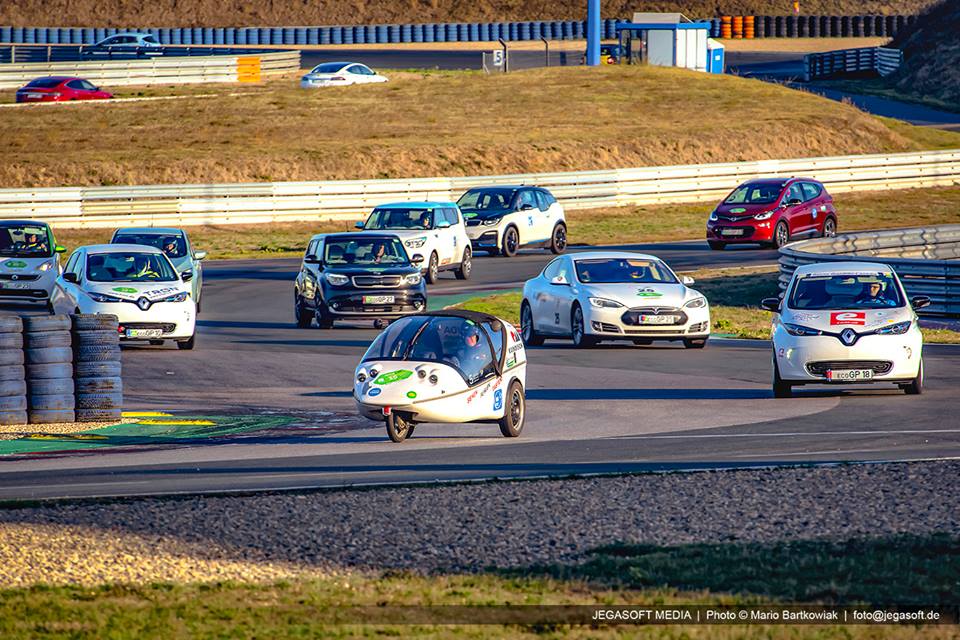
The Eco Grand Prix series is an action-packed and exciting, non-stop electric car marathon. The third challenge of the 2018 series took place on December 1-2 at Motorsport Arena Oschersleben near Magdeburg.
Rules
Only 100% electric cars are permitted and the maximum driving time for one driver is limited to 8 hours in total. Unlimited driver changes and charging stops are allowed. All vehicles compete in their classes and set the world’s first 24-hour record.
Goal
The team that completes the most laps in 24 hours in its category wins the gold medal.
The TWIKE Gerbil Team
A private TWIKE team took on the challenge. On board were the pilots Dirk, Lutz, Wolfgang & Dieter. An exciting experience, but read for yourself in the personal reports.
Participants and placement
The TWIKE team came 8th out of a total of 32 participants. Jutta Kleinschmidt was close behind in a BMW i3.
Impressions
Personal reports from TWIKE pilots
Dirk Wiskirchen
I made my way to Oschersleben on Friday morning. I made the journey by folding bike and train. As I had chosen the cheapest connection, I had to change trains four times and hadn’t actually expected to arrive in Oschersleben on schedule at 16:25. But sometimes the train does manage to surprise me.
Once there, I decided to drive to the vacation apartment that our team boss Wolfgang had rented for us. It was only 700m from the station. When I drove up to the apartment, the landlady was just handing Lutz the key. As I didn’t know any of my team members beforehand, I first got to know Lutz and then we moved into the apartment together.
Afterwards we drove together in Lutz’s car to the arena about 5 km away. Dieter was already waiting with his TWIKE in our allocated pit number 15 to recharge his batteries. While we were charging, we had a nice chat and spoke to our team boss Wolfgang on the phone. He and the rest of our team were still at home and working hard on our racing car.
After Dieter’s TWIKE was fully loaded, he and his wife drove to the accommodation and Lutz and I drove back to Oschersleben. After a good dinner at an Italian restaurant and when it was clear that our vehicle wouldn’t arrive until the next morning, we went to bed.
The next morning, we were in our pit on time for the technical inspection of the vehicle. Dieter was already there, but unfortunately our racing mouse was not. To keep up appearances, we first parked Dieter’s TWIKE in front of the pit. When our vehicle was due for scrutineering, we asked the other participants to come first. Shortly before 9, Wolfgang finally arrived with our race car and the rest of the team.
But now quickly put the trailer in the box and take the TWIKE out for scrutineering. Then straight on to rider registration and briefing. The procedure, rules and behavior on the race track were explained in detail to all riders.
We then had little time to equip the TWIKE with stickers, license plates and the transponder for the lap measurement before we started the tourist lap. After the tourist lap, the riders had the opportunity to do a few test laps. Each rider was able to take a look at the course and the function of the transponder was checked. The TWIKE was then plugged in for a full charge before the starting grid at 1 pm.
At 1 p.m., I was the first driver from our team to take to the track. In the pit lane, we had to line up one behind the other, sorted by starting number. The organizer Rafael de Mestre drove ahead in his Tesla and we had to drive the first lap of the course behind him. On the home straight, we lined up according to our start numbers. Then the wait for the start began. Photos were taken and someone from the organization team went to each vehicle and photographed the mileage of the vehicle.
Shortly before the start, Rafael told us to “Start your engines”. As expected, of course, nothing happened and it was still wonderfully quiet. Ten seconds before the start, the traffic lights turned red and at two o’clock sharp the race finally got underway. After a few laps, I slowly got used to the track and tried to do my laps at a steady pace. Thanks to my rather calm and considerate driving style (perhaps not quite ideal for the racetrack) and a lot of pedaling when accelerating behind the bends, I was able to keep my energy consumption very low. I did my laps like this for several hours until I was thrown off track on the bend to the home straight and unfortunately ended up in the gravel.
As the TWIKE couldn’t get out of the soft gravel under its own power, the race was interrupted and I had to wait for help, which arrived after just a few minutes. I actually wanted to continue straight away, but they insisted on a short health check. I was then escorted to the pits by the marshal in front.
When I got there, the race was already going on. After a brief discussion with the team about whether everything was OK with me and the TWIKE, we agreed that I would continue until my four-hour riding time was up. So I got back out on the track and continued my laps. What we didn’t know at the time was that we weren’t actually allowed to continue until we got clearance from race control. We were given a 30-minute penalty for this and for the interruption to the race.
We had agreed that we would drive into the pits to charge and change drivers when the battery voltage reached 340 V. When you’re driving along like that, you completely forget the time and that each driver is not allowed to drive for more than four hours at a time. My teammates tried to reach me by phone, but in the meantime the battery was empty. So they stood on the route and gave me signals with a flashlight and red jacket, which I eventually understood. I rode 214 km on my stage, started with a full battery and still had a battery voltage of 346 volts and approx. 8 Ah after more than four hours on the route.
After the TWIKE was fully recharged in 50 minutes with our team neighbor’s charger, Dieter was allowed to take a seat in the pilot’s seat. Unfortunately, he had to serve our 30-minute penalty before he could set off.
While Dieter did his laps, our team and Team Extension, who shared the pit with us, had a great time.
After his riding time had expired and the battery was empty, Dieter returned to the box and the TWIKE was immediately powered up again. After the battery was full again and Lutz took off, we made our way to our vacation apartment to sleep for a few hours. When we got there, it was already just after 1 a.m. on Sunday.
We were to be picked up again around 9 a.m. so that we could sleep for a few hours. In the morning, of course, the first thing we did was look at the live tracker and were totally happy that we were in the top 10. When we arrived back at the race track, Lutz was driving. Unfortunately, it had started to rain early in the morning, so the conditions were not so good. Wolfgang then took the wheel again for the last few hours and was supposed to drive the racing mouse across the finish line. Everything went smoothly until the end. The TWIKE ran like clockwork and once again showed what it was made of.
All the vehicles were cheered through the finish line and the cheers continued as they drove into the pits a short time later. Photos were taken of all the teams and then it was off to the award ceremony for the first three places, which was made especially for television.
Afterwards, we all went to the hotel right next to the arena, where all teams received a certificate and medals for the class winners. We thought it was a shame that some teams headed home straight after receiving their awards. Of course it was a long 24 hours, but the last teams were a bit lost. Unfortunately, so did our friends from Team Extension, even though they delivered such a great race with their “streetcar”.
It was an unforgettable weekend.
Many thanks to our team boss and super driver Wolfgang, who made this adventure possible in the first place. The drivers Hans Dieter and Lutz and our hard-working helpers Ann-Kristin, Mimi and Bernd. Many thanks again to Team Extension with the EWolf Multicar from neighboring box no. 16, with whom we had a great time. I hope to see you again next year.
PS: By the way, to answer the Tesla drivers’ question: No, we didn’t freeze at all in the TWIKE, but sweated extremely.
Dieter Bleckmann
The journey with our TW 135 went smoothly, as usual. A friendly wave-through at the entrance to the Oschersleben racing arena, they knew the TWIKE, Wolfgang had been on the race track 14 days before for test drives. The friendly organization team from the organizer Rafael de Mestre registered us, where I got number 15 for our TWIKE racing mouse.
Then we went to pit 15, where everything was prepared, everything went well, only our TWIKE was still in Rosenthal for treatment. On Saturday from 8:00 to 9:00 the technical inspection of the emergency vehicles took place. Lutz and Dirk were already there, Wolfgang then came with the many helpers, without whom it would not have gone so well. At 9:00 a.m. there was a drivers’ briefing, where it turned out that the route had been shortened from 3.65 km to 2.48 km and that a route that was not suitable for the TWIKE had been omitted. Then, from around 11:00 a.m., a tourist lap without a helmet was allowed behind the safety vehicle, where visitors were also allowed to ride. After that, free practice for the drivers, then they were allowed to load up and from 13:30 they lined up on the race track according to the starting number order. Dirk wanted to be the first to drive, as he knows the track better in the dark.
Our strategy was always to drive for 4 hours so as not to give away any laps, as all drivers were only allowed to drive 2×4 hours and the energy of 20kW/h should be enough. For charging, 13kW from our chargers or 20kW power from the neighbor of pit 16 were available when he did not have to charge, so theoretically 20h driving (possible 5x 100 laps) and 4h charging. Dirk drove so economically and also achieved good times under 2:30, which allowed us to reach our goal. There were two corners that were not so smooth and the turn-in point and apex were difficult to see in the dark, so Dirk slipped and ended up in the gravel, where the TWIKE tipped over. According to the rules, we got a penalty and lost about 1 – 1.5 hours. Dirk then drove on, just an experienced motorcyclist (Toni Mang, multiple world champion, also got straight back on when he crashed) would have needed a technical clearance from the race organizers, unfortunately this was not clearly communicated. I then had to serve the penalty in the pit lane in the TWIKE without charging. I then needed a few laps in the dark, found a few good slipstreams, e.g. BMW 3is, and on the home straight the pull of the other cars was so great that I was able to switch off the engine. So I was able to drive the battery into the 20% discharge range in order to have a short charging time again. I then handed over to Lutz and went to sleep.
I didn’t have an exact overview of where we were and when. In the morning, when I got back to the track, Wolfgang rode the rest, as he was already a guarantee for many laps due to his riding style. We were then joined by participants and visitors who were amazed at how well the TWIKE had kept up with the competition. Rafael was also amazed, although he had also considered a TWIKE before buying his first e Tesla Roadster. It was a super great experience, with a great team, good organization and lots of e-vehicle enthusiasts! THANK YOU!
Lutz Förster
Here are my impressions: It was a very sporty start, actually as always, our TWIKE only arrived at the end of the technical scrutineering in the motorsport arena, quick technical scrutineering, registration of the drivers, driver briefing, stickers on our vehicle, the plugs of the specially assembled power charger did not fit together, no spare parts with us.
Nothing unusual for us, but exciting as always ????.
Bernd had registered as a driver with another team – but had forgotten his driver’s license, so he wasn’t registered as a driver. That was good for us, as Bernd was available to us as a loadmaster the whole time.
Our team was formed on site without much consultation: Bernd – loadmaster, Wolfgang, Dirk, Dieter and I as drivers. We quickly decided on the order of the drivers and off we went with our youngest, Dirk. Wolfgang’s niece Ann-Kristin took over, whether voluntarily or not ???? took over the organization within our driver’s box for the entire 24 hours.
Everyone had brought some equipment and food with them, so we had a coffee machine without pods, a filter coffee machine without coffee, instant coffee, a kettle, plenty of provisions and a hanging infrared heater that reminded us of rearing chicks. The constant wind made it feel very cold, which was also clearly noticeable in the driver’s box. Directly under the infrared lamp, you had to make sure you didn’t get sunburnt while the air froze all around you. Until my first lap at 01:00, I also had time to visit the other pits and see what others had in terms of charging technology, technology and organization. There was everything from electrically driven beer crates (unfortunately without contents) to vehicles covered with painter’s fleece and heated from below with heating plates during the charging process, to computer-aided charging processes and lap evaluations.
My first lap started as planned at 01:00 in the morning and went on until 05:00. It is dark at this time of day, but it felt particularly dark. Neither the racetrack nor the pit lane was illuminated.
The 4-hour drive “in circles” literally flew by – or intoxicated – constantly tense, not all drivers drove loyally … but most of them did.
What stood out was that we had no connection between the rider and the pits. The cell phone/helmet circuit is not a practical solution in TWIKE.
At 05:00 we went to the pits – loading and Wolfgang drove on.
I slept for what felt like about an hour in our transport trailer on a kind of folding chair curled up in a sleeping bag, with Bernd next to me on a sleeping mat and some of our crew and the crew from our neighboring box in front of us. It resembled a vagabond camp during the battle ????
We had briefly agreed that Wolfgang and I would ride the final laps, so first me again, this time for 3 hours – then loading – and Wolfgang for the last 3 hours. During my tour, it started to rain continuously, which made the race even more difficult.
It was very good to have two “old hands” like Wolfgang and Dieter in the team. During the night, Dieter had managed to move us up from 26th place (due to our penalty time) and Wolfgang made up for a lot with his positive “go-getter driving style”, while Dirk and I were responsible for the regularity.
We are proud of our 8th place. I am convinced that the next 24-hour eco GP will be completely different. Everyone will start with much better preparations … and so it will be exciting again ????