Rosenthal – a small Hessian town in the middle of the gentle, green hills of the Burgwald – Feldgasse 6: work on a new electric car is concentrated here. It is still mainly model sketches on the computer. Only one prototype of the vehicle stands in the 250 square meter hall, which is an office, workshop and production facility all in one.
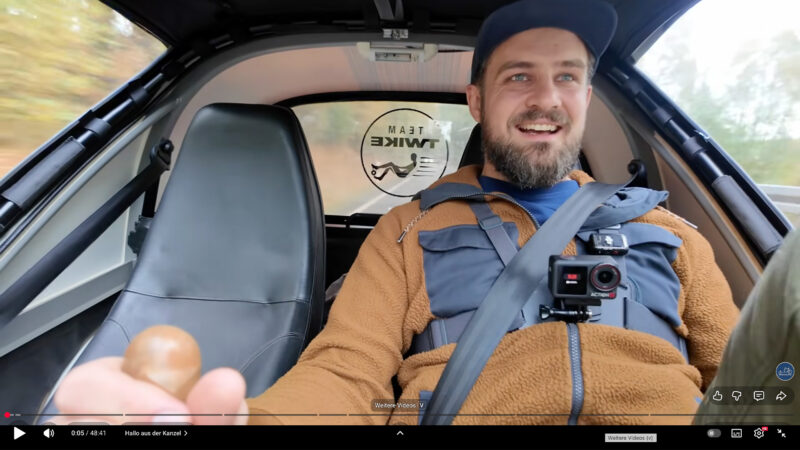
“My name is Martin Möscheid and I am the Managing Director of FINE Mobile GmbH. And we are here in the hall where the Twike 3 is produced, but also where the Twike 5, which is our new model, is being developed and will be launched. Twike stands for twin bike, two bikes parallel to each other in a recumbent position, enclosed in a capsule that looks like a small airplane without wings.”
The battery can be charged using muscle power
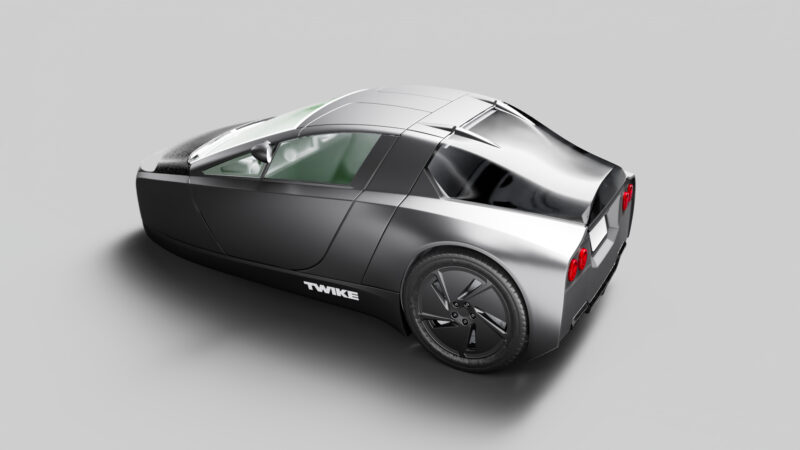
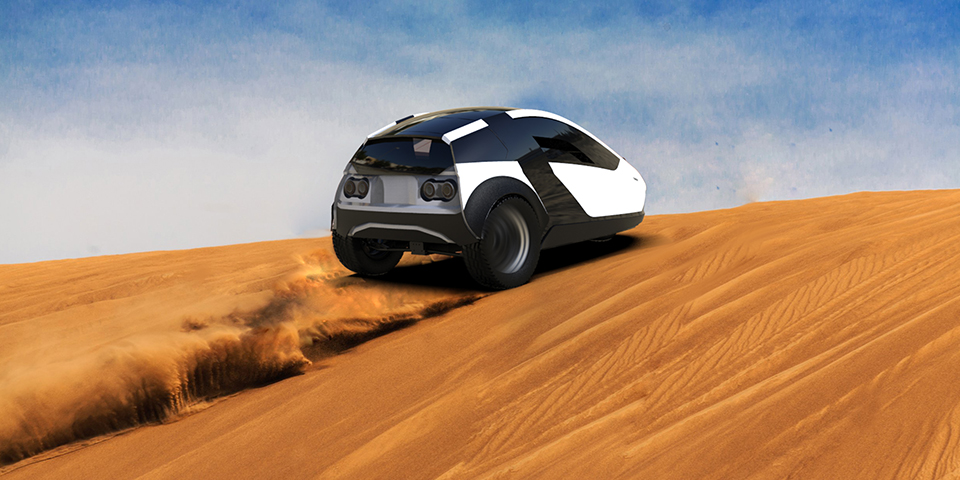
In fact, the prototype resembles the front part of a glider. A fully clad bumper car would also fit the bill. The e-car is a good three meters long, 1.55 meters wide, barely higher than a Polski Fiat and comes with three wheels – two at the back and one at the front.
The special feature: The battery can be charged using muscle power. Martin Möscheid opens the hood, swings himself into one of the two seats, puts his feet on the pedals and takes two metal steering levers in his hands.
“It ‘ s a bit like sitting on a coach box: you can pull on one rein and it goes to the right and then you can pull on the left rein and it goes to the left. And the movement sequence is basically similar to driving a car. If I pull my left arm backwards, the vehicle moves to the left . “
The manager closes the hood, rolls out of the yard and turns onto the Marburger Landstraße. He presses a button on the right-hand steering lever with his right index finger. The prototype accelerates to 100 km/h within seconds.
“It’s actually quite quick to accelerate. You can now switch to cruise control and drive your route at a constant speed. We have the sides open, so a crosswind is coming in. I’m now using the second button to decelerate. We generate energy in the process. That’s nothing unusual. And here we are back in the workshop.”
European motorcycle license is required
Up to three lithium-ion battery modules with an output of 31.5 kilowatts and a three-phase electric motor provide energy or propulsion. In this most powerful version, the Twike can reach speeds of up to 200 km/h. At a moderate 120 km/h, two people plus 250 liters of luggage should be able to travel over 500 kilometers in everyday use.
Charging takes place via a Schuko household plug, for example. In addition, braking energy is fed back into the battery during operation. This is done via the brake pedal and the so-called brake button, which Martin Möscheid demonstrated. Only the electric brake is used to generate energy.
“You can also pedal while riding and increase your range. But more importantly, you can support your health. You can simply move while you are moving. The Twike 5 is a pedal generator. You pedal and generate energy. This is first fed into the 12-volt system. And if there is a surplus, it is then transformed up to the voltage of the drive.”
All you need to ride the Twike 5 is a European motorcycle license. In a course lasting around two hours, customers learn how the steering works, for example. In terms of safety, the vehicle is said to perform better than a motorcycle. The lightweight electric vehicle consists of a tubular aluminum frame with a roll bar. It is to be encased in natural fiber-reinforced plastic. Compared to its predecessor, the batteries have been moved from the rear to under the seats.
What’s still missing: two million euros
“The classification we are aiming for is class L5E; this is a three-wheeled motor vehicle over 45 km/h. It has to meet general safety requirements. So we don’t have to prove crash tests, but we do have to have a frame structure that can survive an accident. We have set ourselves the task of, for example, absorbing pole impacts, rollovers, rear impacts and frontal impacts with the structure.”
To date, a good 200 people want a TWIKE 5. What Martin Möscheid still needs to start production of the e-car-bicycle hybrid is two million euros. This is to be raised from the community of TWIKE enthusiasts. Almost 720,000 euros have already been raised through this type of crowdfunding.
Source: deutschlandfunk.de