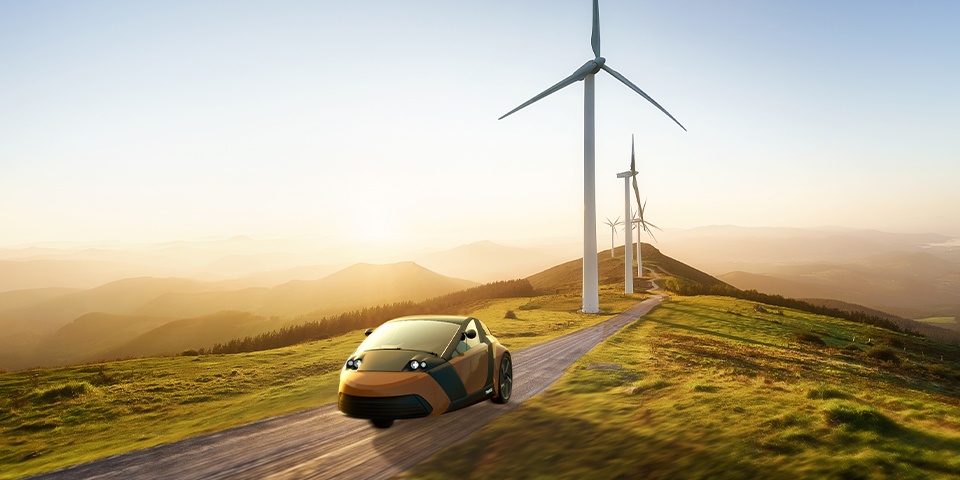
The V236-15.0 MW turbine from the world’s largest wind turbine manufacturer Vestas, whose rotor has a massive diameter of 236 meters, has an output of 15 megawatts, or 15,000 kilowatts, according to the company website. To calculate how long this offshore wind turbine would take to charge an electric car, you have to make a few assumptions. For example, its speed, which also depends on the wind speed.
A typical, average speed of such systems is around ten revolutions per minute. If the system runs this fast, it generates 25 kilowatt hours (kWh) with one revolution, which takes six seconds.
That’s how long the VW e-up! and Tesla Model X would have to charge at the wind turbine
The small and very economical VW e-up! has a consumption of around 16 kWh per 100 kilometers , meaning that the e-up! can travel 156 kilometers on the electricity generated by a single rotation of the Vestas V236-15.0 MW. With its battery capacity of around 32 kWh, the electric vehicle would be fully charged in just under 13 seconds – if such charging capacities were possible. Assuming an annual driving distance of 14,000 kilometers, the wind turbine would need nine minutes to generate enough electricity for a whole year of driving.
In the much less economical Tesla Model X, which consumes around 25 kWh per 100 kilometers, the wind turbine ‘harvests’ enough electricity for at least 100 kilometers with one revolution. The battery of the Model X has a capacity of 100 kWh in the ‘maximum range’ version – so 4 revolutions and 24 seconds are needed to generate the electricity for a full battery charge. If we also assume an annual mileage of 14,000 kilometers, this requires 3,500 kWh of electricity, which the wind turbine generates in 140 revolutions or the equivalent of 14 minutes.
Of course, not all wind turbines have an output of 15 megawatts. On land, for example, turbines with an output of 3 or 6 megawatts are common. Because the wind does not always blow on land, it makes sense to calculate with the average annual production: One such wind turbine produces around 4 million to 7 million kWh per year. If we assume only 4 million kWh per year, then a single wind turbine of this kind supplies the electricity for around 2,000 e-Ups (with the standard annual mileage of 14,000 km).
The annual output of the Vestas offshore wind turbine depends on the installation location. In good, as yet undeveloped locations in the North Sea, 4,500 full-load hours per year are expected, i.e. 4,500 kWh of electricity are generated per installed kilowatt of turbine output. With the V236-15.0 MW, this adds up to 67.5 gigawatt hours, which is enough for 30,000 e-ups, i.e. over 400 million kilometers.
However, the average output of a wind turbine continues to increase with developments in efficiency. The 15 megawatt Vestas wind turbine is not the end of the line. Even larger wind turbines are already in the development planning stage.
Source: efahrer.chip.de
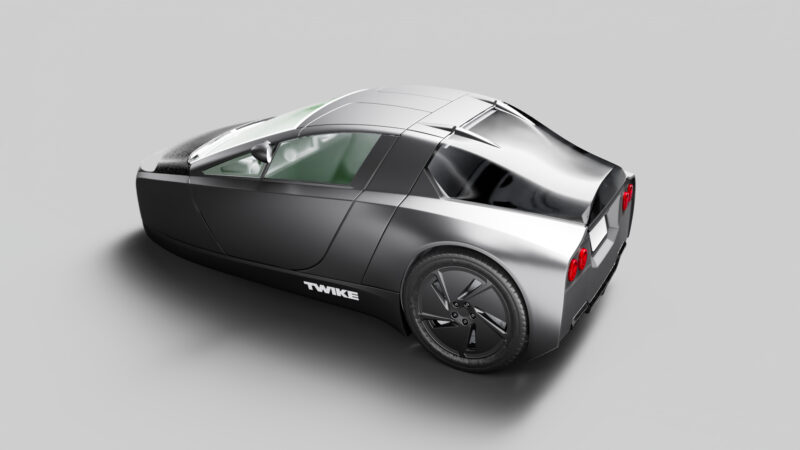
And what can be deduced from this for the TWIKE 5?
The consumption of a TWIKE 5 will be around 7 kwh per 100 km.
According to the article, an average of 25 kWh is generated during one rotation of the Vestas wind turbine.
With this amount of energy, a TWIKE 5 will have a range of (25 kWh / 7 kWh * 100 km) 357 km.
Isn’t that impressive?