elektroauto-news.net, 19.09.2022
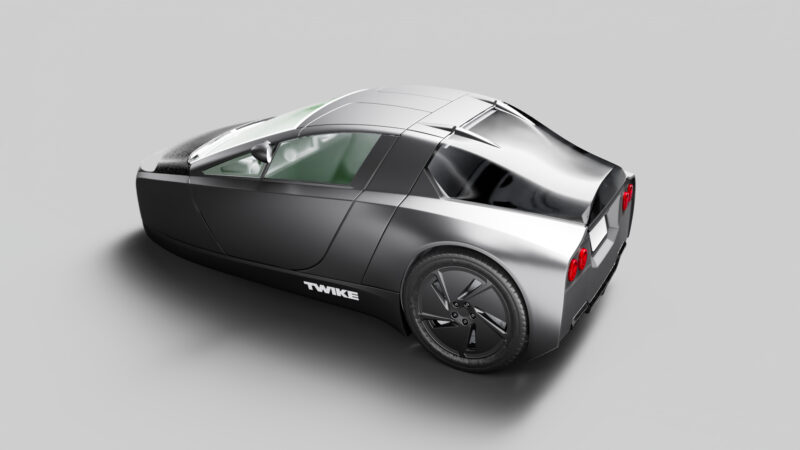
The TWIKE is designed to be much simpler than a car and is in many ways more comparable to a motorcycle. It is only 3.3 meters long, 1.5 meters wide, and 1.2 meters high. It seats two people, has a top speed of 190 km/h, can travel more than 500 kilometers on a single battery charge – and weighs just 600 kilograms. The manufacturer benefits from the compact dimensions when it comes to manufacturing the current TWIKE 5 model. This is because the final production facility essentially consists of an optimized work platform where all the necessary steps for final assembly can be carried out.
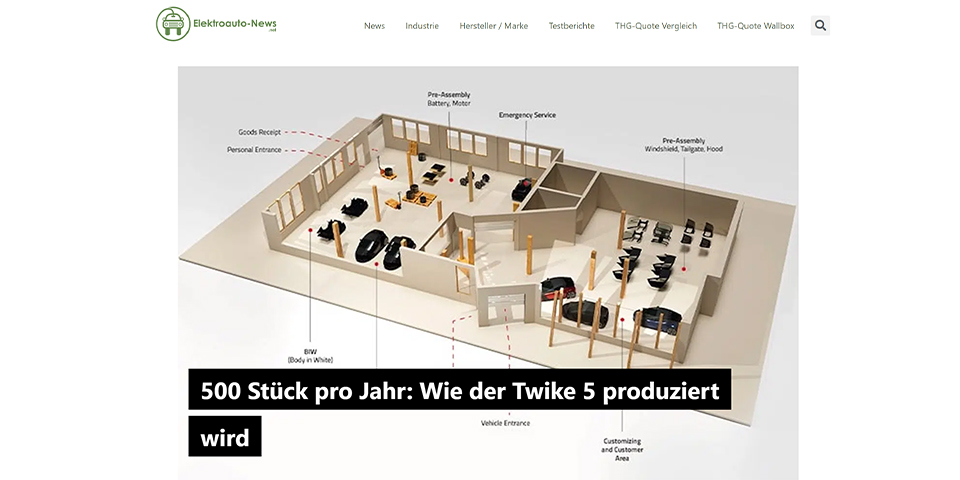
While in automobile manufacturing the vehicle flows along an assembly line toward the materials, at TWIKE the materials flow toward the vehicle. Unlike in automobile manufacturing, the manufacturer does not need a paint shop, which saves a lot of space and energy. A 250-square-meter hall was available for the complete production of the previous TWIKE 3. For the switch to the production of the TWIKE 5, the Rosenthalers added another spacious 300-square-meter hall.
All components required for final assembly are manufactured by experienced suppliers with many years of expertise in the automotive sector, according to the manufacturer. After delivery, the components are supplemented at pre-assembly stations and assembled into larger subassemblies. Examples of subassemblies include the battery, the aluminum frame, the drive module, already complete with the camber-active rear axle and the 3-in-1 synchronous drive, as well as the front axle, the disc frame with roll bar, and the cabin hood. The pre-assembly stations already allow the completed assemblies to be tested for functionality.
Production is designed for 500 TWIKE 5 per year
The actual main assembly then takes place on two work platforms optimized for this purpose. There, the pre-assembled modules are delivered at two-hour intervals and one vehicle is completed within eight working hours. Specific customer requests are then fulfilled in a separate studio area. This customization is designed in such a way that it can also take place at a delivery partner’s premises. Starting next year, ten new TWIKE 5s are to be manufactured per week.
The target for the twelve months following the start of series production is 500 vehicles. However, demand for the new TWIKE 5 is significantly higher: according to TWIKE, there are currently over 1,700 pre-orders. The experience gained by the company from the production of the TWIKE 5 will be used to reduce manufacturing costs in the future. The successor model will then be offered at a lower price and produced in higher quantities.
To achieve this, the manufacturer is also prepared to accept a certain loss of performance in the vehicle and, for example, to reduce the current top speed of 190 km/h. “We believe that the demand for a mobility solution such as TWIKE is significantly greater and that, if we can reduce production costs with the experience gained next year, we will be able to appeal to a broader market,” says the manufacturer.