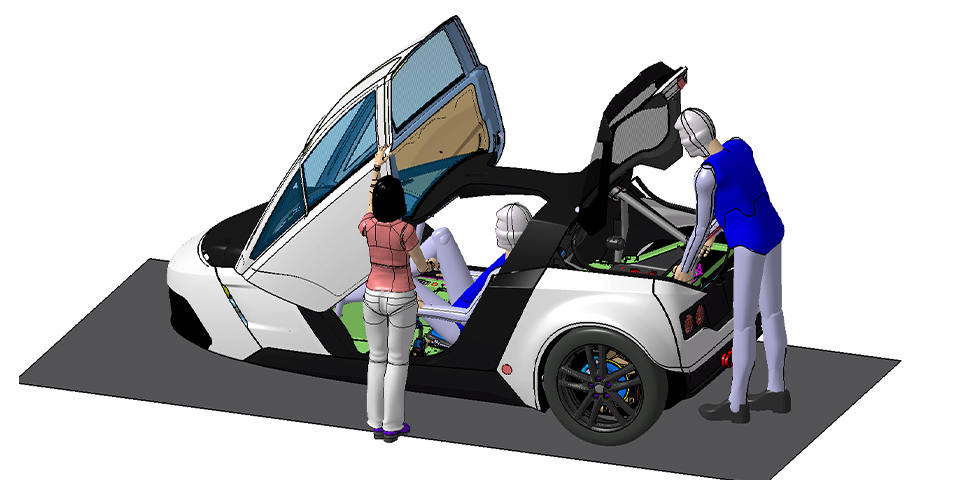
Please get in once and check the seating position. Can the hood be opened and closed from the outside even by a 5-percentile woman with a height of just under 1.53 m? Will a 95-percentile man not bump his head on the tailgate even if he is over 1.86 m tall? Can they both find a seating position where they can ergonomically reach all the controls and have an optimal view out of all the windows?
All of these questions were already taken as a basis when creating the design and have to be checked several times during the transition to series production. All adjustments leading up to series production therefore represent an ongoing balancing act, which the development team is mastering more and more finely and which represents a great quality in the project.
The difference to conventional vehicles is not only the specific ergonomics due to the pedaling in the TWIKE. The ergonomic conditions from the assembly and subsequent service processes are also taken as a basis. The BIW (body in white), which summarizes everything in the deeper core of the vehicle, should also not be touched later during servicing if possible.
The connection of all components, especially the attachment points of all moving components (chassis, hinges, canopy dampers) must also be sufficiently secured to avoid unnecessary costly loops. The preparatory work for the last development loop of the BIW for the time being was readjusted and checked once again. The result of this loop will be the set of drawings for a bodyshell that is suitable for assembly, as light as possible and crash-optimized. The selected production method is suitable for small series production and will allow the first samples for the driver test vehicle to be produced once the loop has been completed.