klimareporter.de, 27.04.2023
All parties in Germany lack essential building blocks for such a policy.
May I tell you about my dream? I dream of seven-league boots, not electric cars. I got that from Robert Musil’s novel of the century, “The Man Without Qualities,” which attempts to separate the magic of possibility from mundane reality.
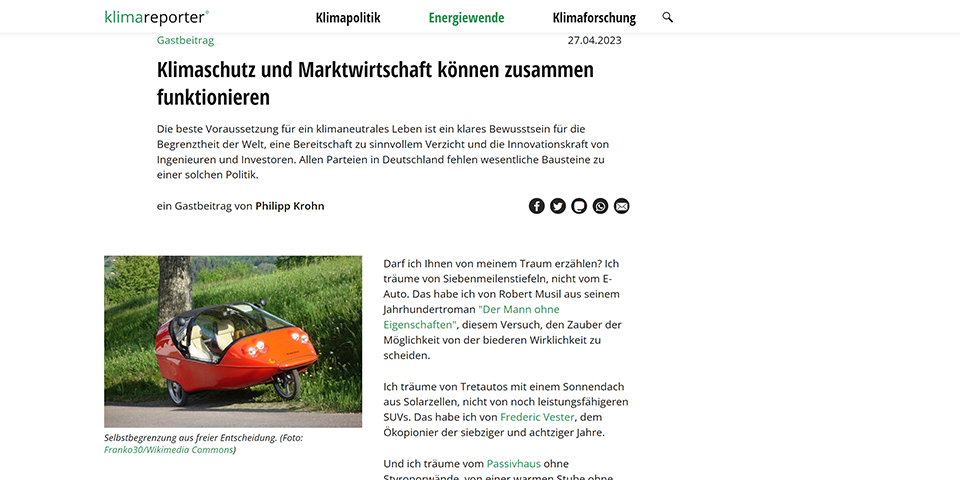
I dream of pedal cars with solar panel sunroofs, not even more powerful SUVs. I got that from Frederic Vester, the eco-pioneer of the 1970s and 1980s.
And I dream of a passive house without Styrofoam walls, of a warm room without heating, but also without harmful hazardous waste. That’s something I’ve experienced in my own life, but unfortunately it hasn’t been realized yet.
We need to hurry up and move toward a climate-neutral lifestyle. We only have a quarter of a century to change the habits we have acquired over decades—and behaviors whose roots go back even further.
The economist Kenneth Boulding, one of the most visionary scientists of the last century, once described the task as follows: “Now that the age of expansion is coming to an end, a whole new set of ideas and institutions that were not previously well suited to survival will become important. The entire future of humanity depends on whether it can manage this adjustment quickly enough.”
I fear that we Bouldings message still have not begun to understand yet, even though the pressure has clearly increased, since he began writing in the 1980s. And because we don’t a28> not take the time to reflect on where we actually want to go in a more sustainable world, are our debates so heated, disoriented and characterized by corrosive camp thinking: eco-moralism clashes with eco-ignorance.
As a result, we argue about banning plastic bags and the barely measurable benefits of organic food instead of focusing on the big issues of sustainability: our harmful ways of traveling, heating our homes, and consuming goods.
From the cowboy economy to the spaceship economy
In the mid-1960s, Boulding wrote a groundbreaking essay entitled “The Economics of the Coming Spaceship Earth.” In it, he spells out the necessary steps on the path from a fossil fuel-based economy to a solar economy.
He makes it clear that it is about a fundamental change in consciousness away – away from a cowboy economy, in which economic people can move on if when they have exploited nature to towards a spacecraft economy, in which all outputs are also again inputs for other actors are. The text is almost 60 years old.
I have thought about this concept repeatedly over the past two and a half decades, adapting my private life with three children, no car, renting a passive house, and consuming sparingly, and yet still causing annual greenhouse gas emissions of 3.6 tons of CO2.
When Fridays for Future and their parents demonstrated, I was a bystander—somewhat taken aback by the banners calling for fundamental systemic change. Yet socialism has never been more environmentally friendly than capitalism. I was taken aback because I believe that the sustainable goals I dream of can only be achieved through a free market economy without prohibitions, but with much clearer ecological guidelines.
Soon, I was certain that my two decades of knowledge were sufficient to enable me to make a decision. a4> my two decades old insights into biophysical limits, our limited metaphorically shaped view of growth (“sick man of Europe”) and the reflections of ecological economists such as Nicholas Georgescu-Roegen and Malte Faber on the irreversibility of environmental problems with a35> the current debates had to be brought together. This resulted in the book “Ökoliberal: Why sustainability needs freedom” which was published at the end of March.
It is an attempt to formulate a much-needed synthesis: between a perspective that recognizes the scope of the ecological crisis and is aware of the limits that have already been exceeded, and a perspective that understands that comprehensive investments are necessary to establish a less harmful way of life. Creativity, as a prerequisite for innovation, should be stimulated not by prohibitions but by clear reduction targets.
Three liberal economists
When thinking along these lines, one quickly arrives at a triangle of liberal economists who lay the foundation for an idea that seems promising to me for a sustainable transition: eco-liberalism. From John Stuart Mill, we can learn how to value freedom highly, but not see its fulfillment in generating eternal growth dynamics—even if this goes hand in hand with increasing environmental damage.
Friedrich August von Hayek, despised by many as the forefather of neoliberalism, had a keen environmental awareness and believed that bans were effective in cases of health hazards, but otherwise relied on the price mechanism as the most successful medium of information. He believed that the uncoordinated actions of all individuals lead to better results than the directives of a regulator who presumes to have comprehensive knowledge.
Amartya Sen ultimately developed a complex understanding of freedom, which goes far beyond the fulfillment of immediate needs and a17> and which requires the development of individual skills and abilities.
An eco-liberal approach is therefore as follows: recognition of planetary boundaries, the selection of appropriate market-based instruments—such as emissions trading with strict reduction targets (zero emissions and an infinite CO2 price in 2050) – and a well-balanced strategy of technology and renunciation based on Aristotle’s demand for the right measure.
This guiding principle is applied by me in my book in a7> various dimensions of sustainability: housing, nutrition, mobility, consumption, on the biodiversity crisis and the topic of circular economy. As an obstacle on the path to a clear sustainability strategy proves to be time and again the same old thinking. In doing so it would be important to elements of social niche innovations such as the resource-conserving Transition Towns quickly to large population groups to scale.
Implementation of an eco-liberal idea
In a groundbreaking essay in Prospect Magazine, British historian Timothy Garton Ash formulated his thoughts on the successful implementation of an eco-liberal idea: identity politics is filling the vacuum left by the lack of political solutions to the ecological and climate crisis.
“The planetary fight to slow down global warming will require a9> require us to curtail the power of the overpowering carbon-exploiting companies, and indeed with means that range from divestment to regulation,” writes Ash. “The costs of our personal lifestyle will be particularly high, if we accept the arguments for a37> historical and intergenerational justice seriously .”
Ecoliberalism, in which consumption is based on moderation, seems to me to be the most attractive model for shaping our development in a sustainable way. According to surveys, the population’s confidence in the market economy remains high despite all the eulogies of socialist climate activists.
Advocates of a controlled economy such as Canadian scientist and activist Naomi Klein openly admit that they use their commitment to climate protection as a vehicle to shape the world according to their ideas of justice. However, the issue of climate change is too important to be used to further other goals.