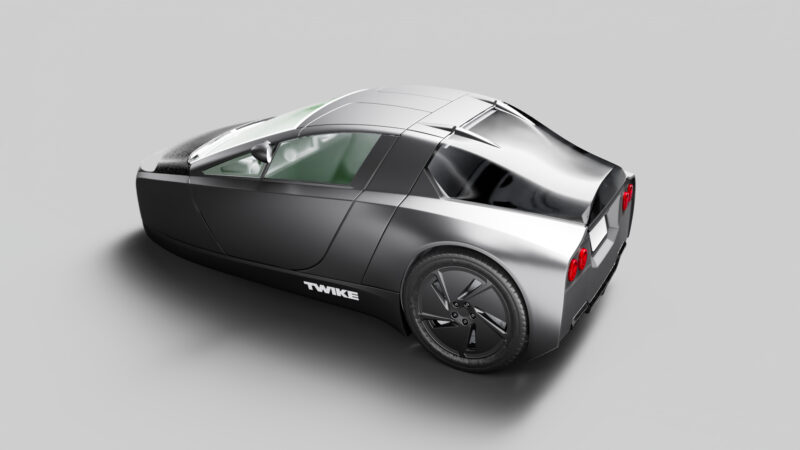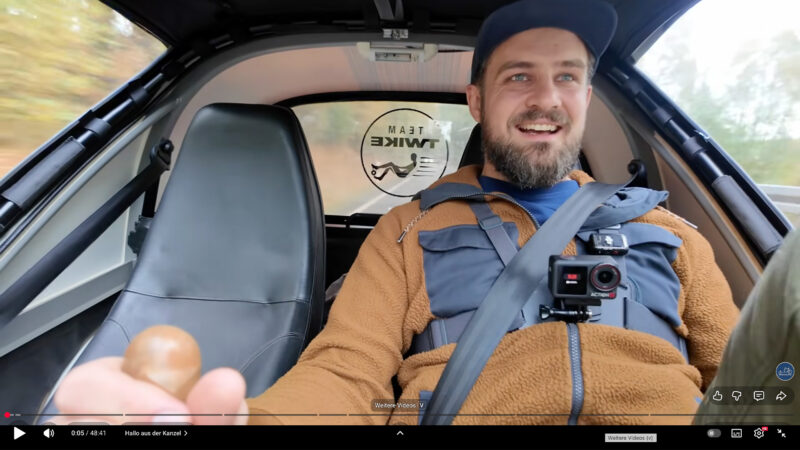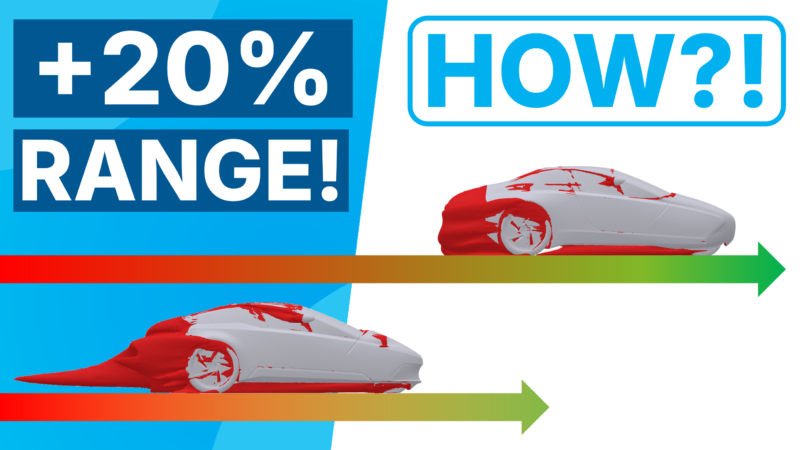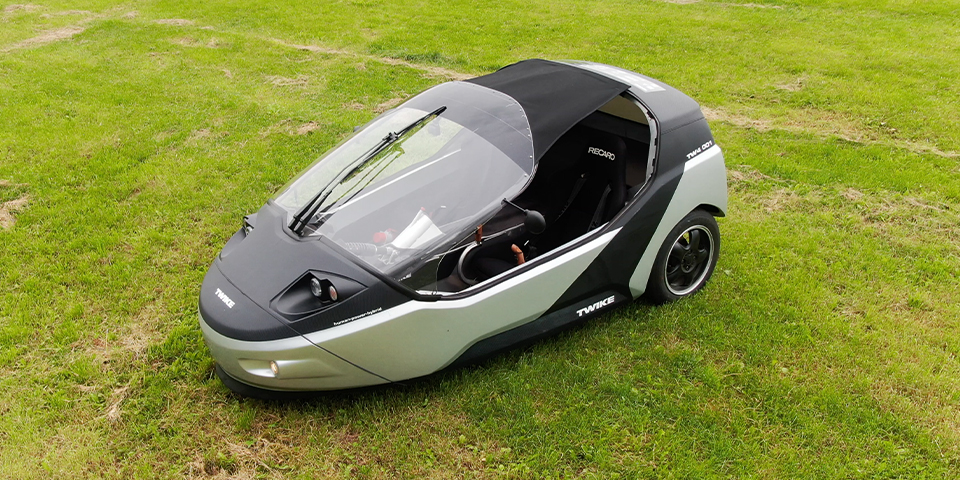
During the test drive of Twike 3 and 4, I was able to learn a lot about the technology behind the Twike. After the test drives, which lasted at least 30 minutes in total, Mr. Moescheid invited us into his “office” to explain a few more details to us.
His “office” was one floor above the exhibition space, which was impressive in itself. The entire building is an energy-positive building in purely mathematical terms, meaning that it “generates” more energy (from the sun) than it “consumes.” In addition, attention was paid to the use of ecological building materials—a lot of wood is visible. And it wasn’t “his” office, but that of the entire team. It housed several PC workstations (five people work there), a large meeting table, a full-scale cardboard model of the Twike 5, a kitchen, and a spare parts warehouse.
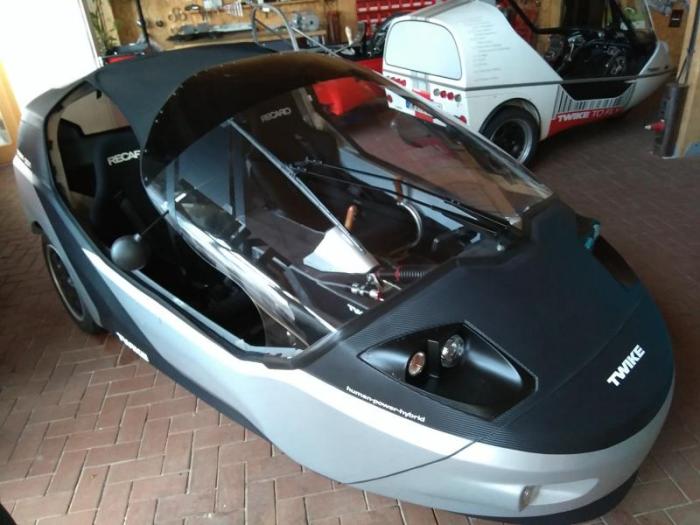
The discussion about a few details ended up lasting about 2.5 hours because I kept asking questions. Besides, I didn’t want Mr. Moescheid to “waste” his time with us without getting anything out of it. I gave him a few suggestions outside his area of expertise because I think the Twike is still far too unknown. The mere fact that there is a vehicle manufacturer within battery range deserves support. When such an ingenious vehicle is the result, I definitely think it’s worth supporting.
What struck us both during the conversation was that Mr. Moescheid is not “sales-oriented,” but rather stands fully behind his product with conviction, yet never tried to manipulate us into buying it or even impose his opinion on ecology. The conversation was characterized by an exchange of expertise in the respective field. I really enjoyed listening to his explanations about the Twike 5 and only then realized how complex the development of such a seemingly simple product as an electric car actually is. His dog also liked me very much…
Here are a few excerpts from the information I can remember:
- The batteries are the same ones that are also installed in the Tesla.
- The performance of electric motors is not comparable (in terms of horsepower) with that of diesel or gasoline engines.
- The range of the Twike 5 can be up to 500 km, depending on the battery configuration.
- The maximum speed of the Twike 5 can reach 190 km/h with 3 batteries.
- Nevertheless, thanks to its special chassis and low center of gravity, it will be very stable, even at high speeds.
- All parts used are standard car or motorcycle parts, so local repair shops (Hello Detlev and Bernd!) can also carry out repairs.
- There will also be the “human” additional drive again.
We then discussed prices. Since every Twike 3 is unique—each one is built individually—the calculation is naturally different from that for other vehicles. There is also no price list to use as a guide.
The Twike 5 will start at €30,000 (without battery). That may sound like a lot at first, but new Polos also start at €15-16,000, and I would definitely count a Twike in this class.
In addition, it has been approved as an electric light vehicle (both the 3 and the 5), which means it can be driven by people aged 16 and over, is tax-free for several years when newly registered, and then there are the lower fuel costs.
I did the math on that last point: if I were to drive my Touran between Aue and Lennestadt on diesel, it would cost €4.07—with a Twike, even under the worst conditions (the battery would be completely empty as soon as I drove into the garage), it would cost just €0.50—and with muscle power, I could drive even cheaper.
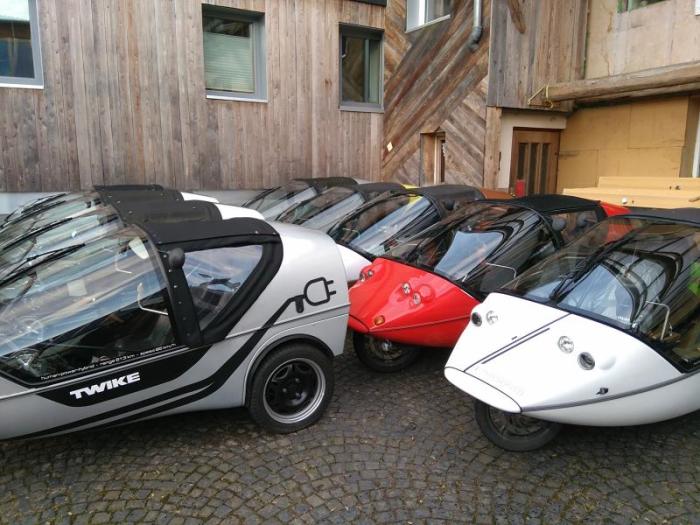
Two further advantages: Taxes for electric light vehicles are naturally lower than for “normal” cars—and not by a small margin. I looked it up: Liability insurance for light vehicles costs between €50 and €150, partial comprehensive insurance between €60 and €120—per year, mind you!

Another factor that speaks in favor of Twike is its durability. There are now vehicles that are 20 years old or older and still run very well. Of course, after 20 years, the battery is worn out, but you can still drive (or replace the battery). (Perhaps another topic from practical experience: During my time as an industrial electrician, I saw electric motors that were over 60 years old and still able to do their job. There isn’t much wear and tear on an electric motor.)
Even though I still want to take a look at the Twizy, one thing is already certain for me: my next car will be a Twike. I’m not sure exactly which one yet. The only thing that is certain is that my journey with Twike will not end here.
And to anyone who complains about the production of electric car batteries (mining of raw materials, durability), I can only say: the mining of fossil fuels is even more questionable from an ecological point of view. Battery aging is also no longer as much of a problem as it used to be.
Source: linuxundmehr.de