Car, bike or helicopter? The TWIKE has an electric motor, joystick and pedals. At just under 27,000 euros, it is more expensive than a Golf Variant. A visit to the makers.
Von Christian Frahm
Martin Möscheid rotates the virtual vehicle model on his screen in all directions. He zooms in and makes the bodywork disappear so that he can take a closer look at the electric motor underneath. Two clicks with the mouse and you can look inside the drive. A quick check, then the vehicle is wrapped in its plastic body again and the virtual journey continues into the cockpit.
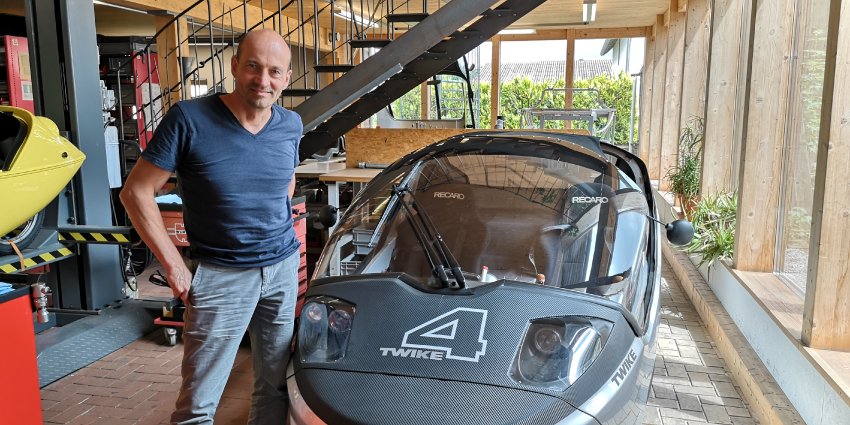
Möscheid is a vehicle developer. Not at VW, BMW or Mercedes, however, but at the electric car manufacturer TWIKE. Together with nine colleagues, he is based in a two-storey house in the tranquil community of Rosenthal in Hesse with its 2000 inhabitants. From here, he sells the electric car that was one of the best-selling in Europe until just a few years ago – the TWIKE 3.
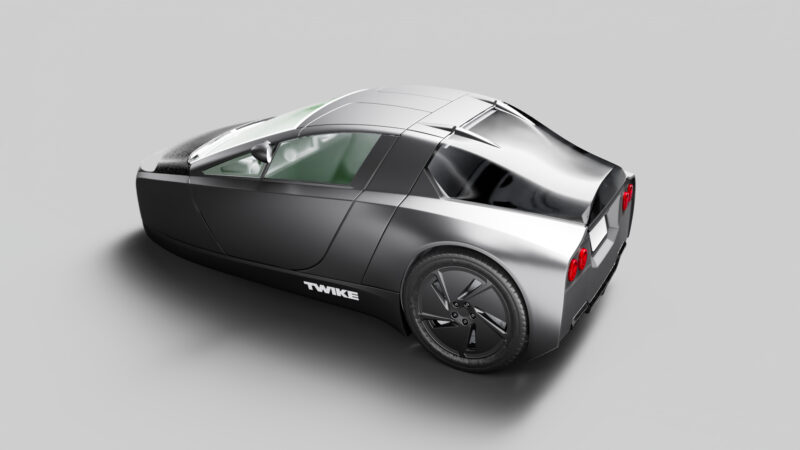
“Fancy a test drive?” asks Möscheid, pointing to the three-wheeled vehicle, which looks more like an express train. The developer pulls up the hood, which slowly rises like the cockpit of a jet and provides access to the car’s interior. Once you have settled into the bucket seats, you see a central display, a joystick that could easily be installed in a helicopter and another lever reminiscent of a handbrake. What doesn’t fit into the picture at all are the bicycle pedals, which are located in the footwells of the driver and front passenger. “The pedals support the electric motor, which can extend the TWIKE’s range by up to 15 percent,” says Möscheid, explaining the unusual vehicle concept. The 50-year-old is a trained car mechanic and studied mechanical engineering.

The history of the lightweight electric vehicle began with a student project. For the 1986 World Expo in Vancouver, students at EHT Zurich developed the original TWIKE: a two-seater bicycle with a body, at that time still without an electric motor and weighing 50 kilograms. The TWIKE reached speeds of up to 50 kilometers per hour using a pedal drive. After years of further development, the newly founded Swiss company TWIKE AG presented the production-ready TWIKE 3 in 1995. Although the vehicle is said to have sold well, the company went bankrupt in 2002. Möscheid, who together with his brother was one of the first purchasers of the TWIKE and was involved in its development, began selling the e-mobile as an importer in Germany in 1998. He bought the TWIKE 3 and from then on built it himself in Rosenthal, Hesse. “That’s how we brought the TWIKE into the modern age,” says Möscheid, releasing the handbrake, pressing the small button on the joystick to accelerate and rolling silently out of the hall.
Lying across the country road
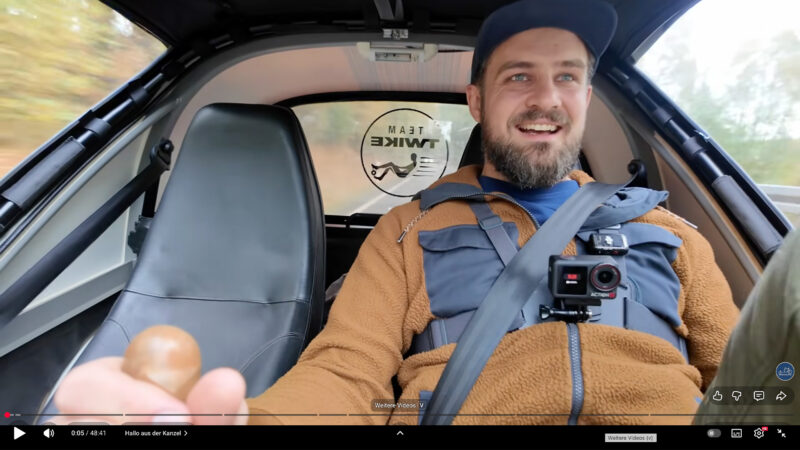
Thanks to the electric motor, the TWIKE accelerates quickly. Once you get used to the unusual reclining position, you quickly enjoy sweeping along the country road at around 60 km/h on three wheels. Möscheid navigates the vehicle over the winding road with fine movements of the joystick. If he presses the upper button, the TWIKE accelerates up to 85 km/h. If he presses the lower button, the e-mobile brakes slowly and smoothly and recovers energy for the battery. The TWIKE even has cruise control. If Möscheid needs to initiate an emergency stop, he uses the pedals – just like on a bicycle with a coaster brake.
Photostrecke
Electric car with pedals: man-machine pedal point
“You wouldn’t actually need the pedals. But we wanted to continue the idea of the first TWIKE, which was designed as a bicycle,” says Möscheid. In addition to extending the range, the switchable pedal drive also has a fitness function. “Many of our customers also buy the Twike because of the sporty aspect. They want to be active while riding and do something good not only for the environment but also for their body with the emission-free TWIKE.” The level of difficulty can be regulated via a five-speed gearshift. Theoretically, the TWIKE can also be propelled up to 20 km/h using only the pedals. “However, given the weight of 270 kilograms, pedaling becomes too strenuous even on the slightest incline,” says Möscheid as he rolls the TWIKE back into the yard.
Range of up to 560 kilometers
In the basic version, the 2.65-metre-long TWIKE 3 has one battery and a range of up to 80 kilometers. The e-mobile can hold up to seven batteries, which are then sufficient for distances of up to 560 kilometers. Moescheid estimates the charging time at the household socket at one minute per kilometer of range. The Twike is powered by an asynchronous motor with three kilowatts of continuous and seven kilowatts of peak power. As a “three-wheeled motor vehicle over 45 km/h”, the TWIKE falls into vehicle category L5E and can therefore be driven with a normal car driver’s license. However, the safety requirements are different to those for cars, for example it does not have to have airbags.
The vehicles, of which well over 1000 have been delivered to customers since the premiere in 1995, are manufactured by hand. A total of ten employees work at the headquarters in Rosenthal, three of them in the workshop. “Once the individual components have been delivered, it takes around 70 hours to assemble each TWIKE on site,” says Möscheid. As the components are not produced in large numbers, they are correspondingly expensive. The base price of the Twike 3 therefore starts at 26,849 euros. If you want more range, a paint finish, a sound system or other extras, the price can be more than 50,000 euros. Möscheid’s customers often buy the Twike as a third vehicle to travel short distances in a sporty and environmentally friendly way, for example to get to work.
Successor model reaches 190 km/h
In the long term, Möscheid and his team are planning to produce the Twike in larger quantities and thus significantly reduce the price. To achieve this, they are already working on a successor model. The Twike 4 was presented in 2010, although it was only planned as a prototype and test vehicle from the outset. In the meantime, development of the TWIKE 5 is already in full swing. If everything goes as planned, the vehicle could go on sale in spring 2019.
The fifth generation will then have significantly more power than the previous model, a top speed of up to 190 km/h and a range of 550 kilometers. A small series of 500 units is initially planned. The TWIKE 6 will then finally be produced in larger numbers, making it more interesting for a wider range of buyers. While the mechanics are assembling a bright yellow TWIKE 3, Moescheid is already back at his computer in front of his virtual Twike one floor up. “Number 147,” Moescheid calls down and is delighted to receive another pre-order for the TWIKE 5. Production begins when 200 reservations are made. “So we still have a lot to do.”
Source: Spiegel Online