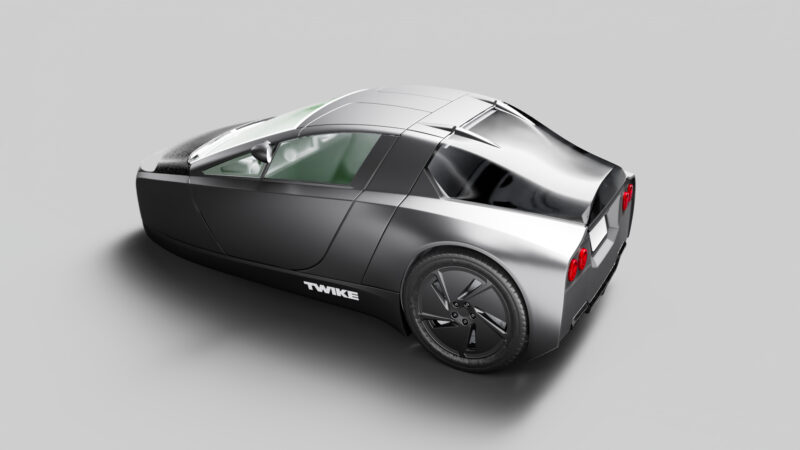
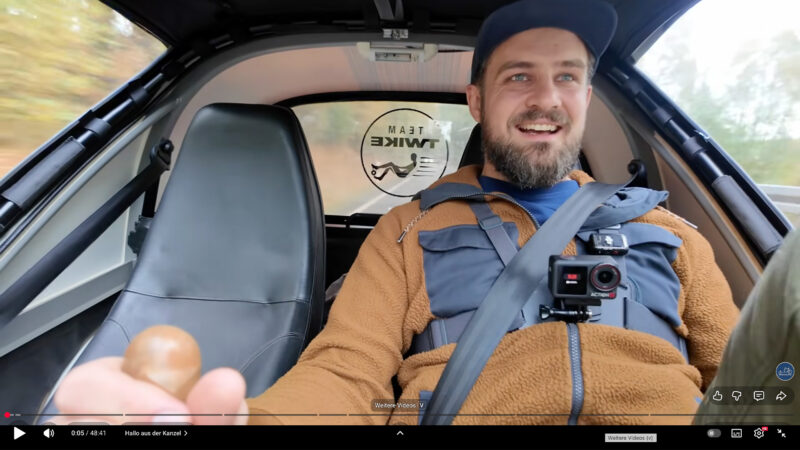
Feeling the safe driving dynamics of this road-hugging machine was an enriching experience. However, the frame – the so-called BIW, Body-in-White, which is black for us – of the first TWIKE 5 FET was only provisionally screwed and tacked up to now.
The next visible step in development is the replacement of the BIW with a bonded and riveted version. The adhesive bond has become established in the automotive industry and is considered at least equivalent. The adhesive also seals at its contact surfaces, and the often weakening heat input from the welding process is eliminated. The findings from the construction of the first model flowed back into the CAD model in all details and are again undergoing the procurement process for the first at least three prototypes.
Visually striking is the black surface coating that takes place immediately after forming (laser cutting, punching, bending, edging). The aluminum components are passivated on their surface by anodizing, preparing them for the bonding process and protecting them for later road use.


So far, sheet metal brackets are being replaced by solid and precisely milled aluminum nodes (see figure, example BIW node rear left for mounting the trailing arms). These nodes allow for optimal load transfer of all driving forces into the frame structure and can still be machined on small CNC machines in the chosen size. In the BIW manufacturing process, they serve as reference components for maintaining dimensional accuracy.
Although there was a delay in the delivery of the aluminum sheets, the individual sheets and other aluminum components of the frame have already been black anodized, and the assembly of the new Body-in-Black* has begun. The dimensional accuracy of the entire assembly is ensured by mutually aligned holes, which are introduced into the sheets with high precision during the laser process. Additionally, the successively larger sub-assemblies are joined together by bonding and riveting on a precision table, so that the specified tolerances can be maintained, especially at the connections of the chassis components.
After the vehicle frame is joined, the current driver test vehicle will be disassembled, and all near-production attachments will be moved to the new frame. After this update, all loads expected in later operation will be introduced with more demanding driving maneuvers, thereby ensuring suitability. You can learn more about the resulting Black FET (driver test vehicle) and the driving tests carried out with it in the following articles.
Would you also like to secure your TWIKE 5 Pioneer Edition at the fixed price of €49,900? Learn more here.
* The so-called BIW, Body in White, which is black for us.
Post updated on September 5, 2024