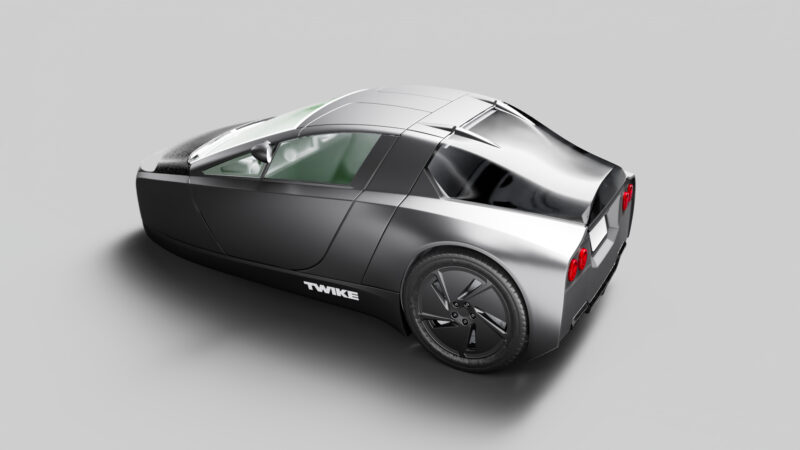
Why are the two wheels on the TWIKE on the rear axle (delta arrangement) and not on the front axle (tadpole arrangement)?
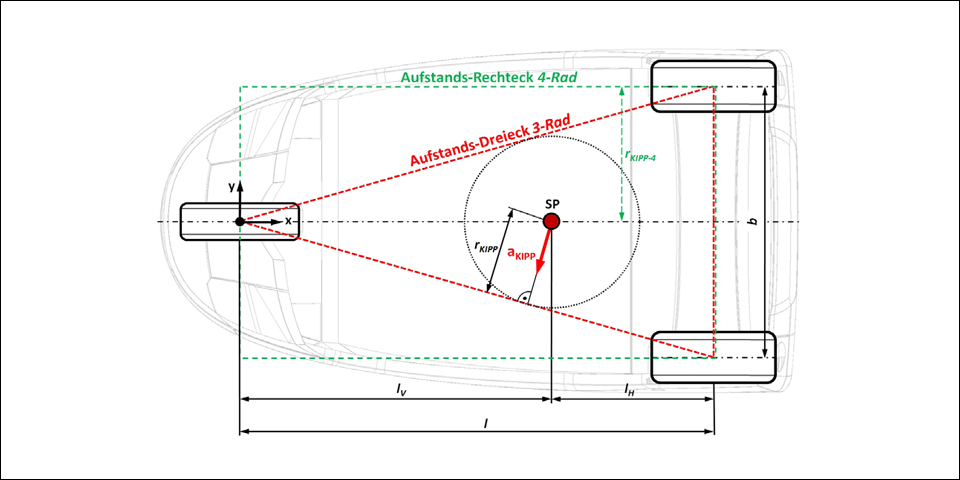
The only argument in favor of two wheels at the front would be the better support of the rolling forces when cornering and braking at the same time. However, this manoeuvre can be controlled just as well in a delta arrangement (one wheel at the front, two wheels at the rear) if the vehicle’s centre of gravity is positioned far to the rear and low at the same time. Advantages resulting from the delta arrangement, such as less critical loading of additional mass (luggage) and significantly greater safety in the event of a rear wheel failure (tire blowout, loss of pressure, but also simply slippage due to leaves on the road), make the vehicle much safer to operate and allow impressive driving maneuvers.
The following facts must be internalized:
The rear axle guides the vehicle and keeps it on track. If the rear axle loses the ability to support lateral force against the road, the vehicle automatically turns around the vertical axis and becomes uncontrollable. If only one tire is available on the rear axle in this situation, there are no longer any safety fall-back options resulting from the redundancy of a second rear wheel. In the speed range up to 45 km/h for e.g. covered recumbents, the impact of a resulting accident may still be statistically acceptable. However, if higher speeds (highway) and greater prevalence and normality of tricycles are addressed, this scenario must be better thought out and prepared for.
To anticipate this question that may now be in the air: No, a tire blowout on a single front wheel also causes the vehicle to stop (as with any four-wheeled vehicle), but it does not automatically initiate a pirouette, but allows the speed to be reduced with extremely increased steering force and in most cases even evasive steering maneuvers.
Apart from the delta arrangement, the chassis solution of the TWIKE 5 no longer has much in common with the TWIKE 3 (e.g. De Dion rear axle with twist-and-slide coupling, single-arm swingarm on the front axle, 2-arm sidestick steering, …). The center of gravity is also considerably lower. The TWIKE 4 already demonstrates impressive stability at high speeds and fast cornering, making even sporty four-wheeled vehicles look bad in demanding maneuvers.
To look at examples from practice, which is particularly sensitive in terms of safety, we can refer to the aircraft industry: The tail wheel solution (one wheel at the rear) is used in aviation. In practice and in industrial aviation, however, the delta arrangement (one wheel at the front) has prevailed due to the simplest safety considerations and is used convincingly every day.
Incidentally, with two wheels at the front, there would also be no more space for the driver and front passenger next to each other, as the passengers would have to sit further forward in favor of a center of gravity to be placed further forward and they would have less space available with their feet inside the wheel arches. In practice, however, this would not usually become a space problem, because in the packaging phase the wheel arches would simply be positioned further out, which would result in a wider vehicle.
We consider the solution found for the TWIKE 5 to be the best of all possible tricycle variants and are very proud of the impressive riding performance and dynamics.
What are the advantages of a three-wheeled vehicle?
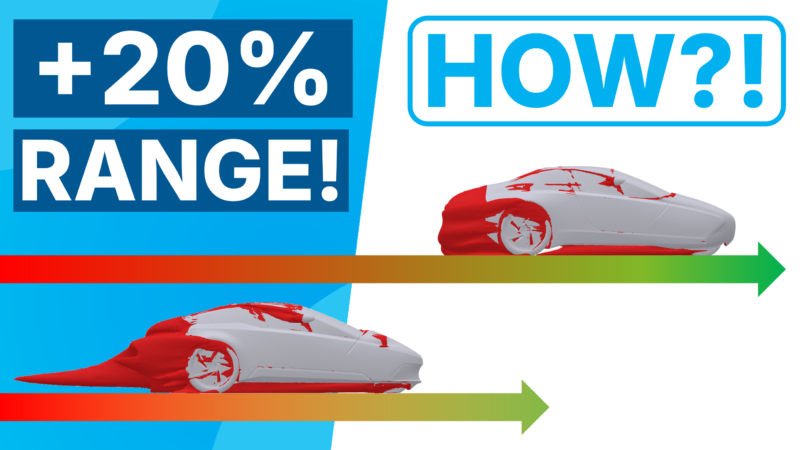
A tricycle requires less longitudinal torsional rigidity and can be built lighter as a result. The front end can also be optimized for better aerodynamics. In terms of registration, the L5e class allows the use of an unlimited high-performance drive and, with the resulting low power-to-weight ratio, allows the vehicle to compete with super sports cars. In the USA, a tricycle designed in this way is a motorcycle, which makes it easier to enter the market, even with a small series.
Would two wheels at the front make more sense for emergency braking?
This is the old misconception. In principle, two legs provide better support at the front and prevent tipping. However, if the center of gravity is sufficiently far back and low, similar tipping stability can also be achieved with a delta arrangement. And especially during emergency braking, the rear wheels should retain sufficient load to avoid a pirouette. This would be at risk if a single rear wheel loses grip. Hence the delta arrangement (two wheels at the rear and a low center of gravity at the rear). For safety reasons, only one wheel is not recommended for everyday vehicles with higher speeds.
Let’s TWIKE!