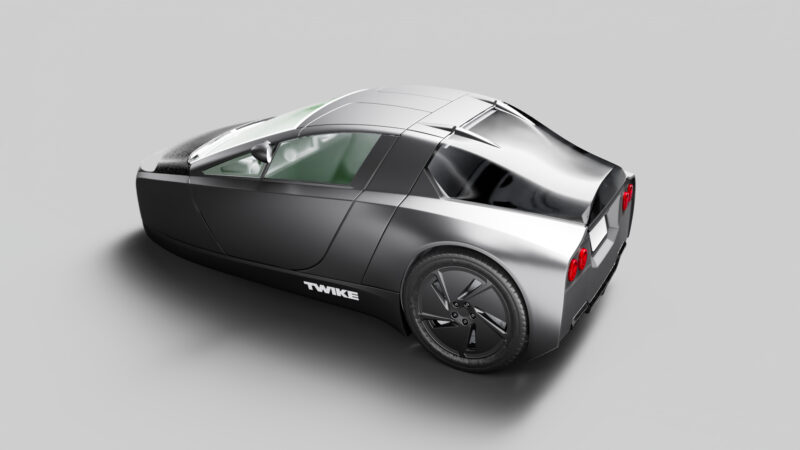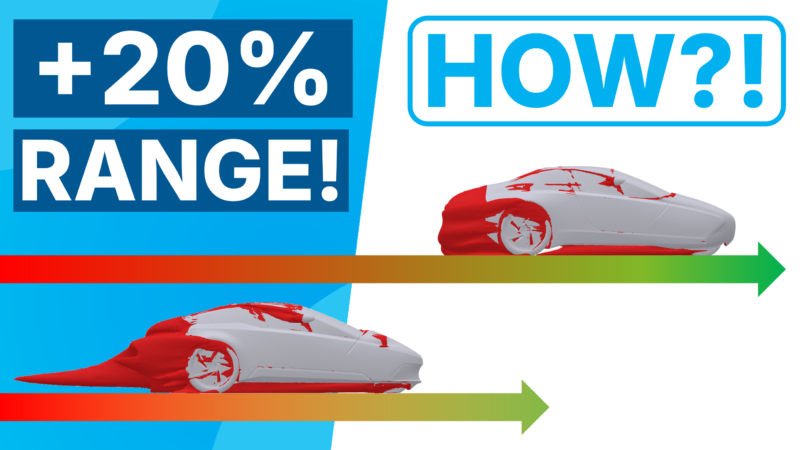
The most important ingredients for a vehicle’s high energy efficiency are low weight, the smallest possible frontal area and a minimized cd value. Friction components from the bearing points of the power transmission and the wheels also play a role. And in all these disciplines, the components selected and the parameters defined in the design process for the TWIKE 5 will set a high benchmark for other market players. But what about the efficiency of the electrical components, e.g. motor, inverter and battery?
At first glance, the designated performance data of the TWIKE 5 (vmax 190, 0-100 <4sec) do not suggest low fuel consumption. Experience has shown that a large combustion engine requires more fuel due to higher internal friction and larger masses. Even an electric motor cannot escape the physics of these influences. However, an electric drive system is already in a different league and the influences have a less serious effect on consumption.
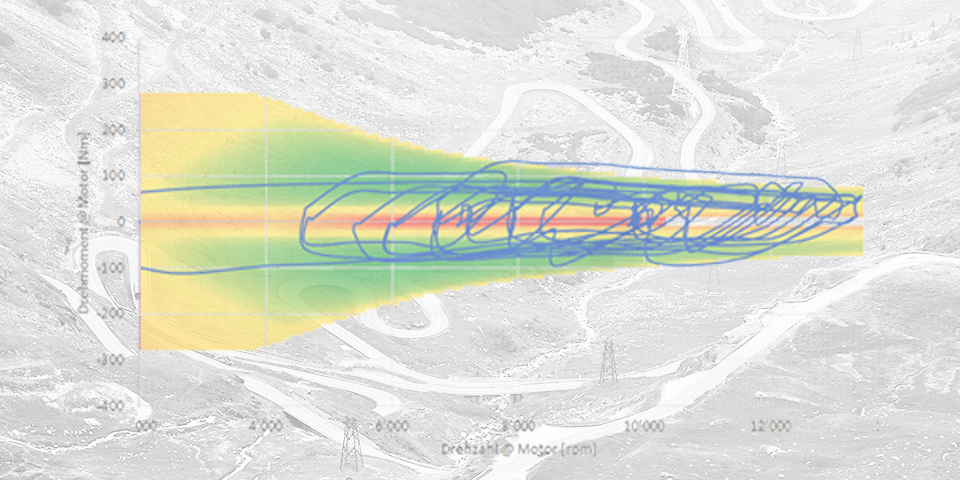
In order to assess the effects of the dimensioning and the interaction of all components at a relatively early stage, the characteristic values of the influencing components determined by measurement can be applied in calculation models with load profiles known or agreed from practice, e.g. the WLTP cycle defined for determining standard consumption, but also a more demanding load profile of a Nordschleife driven on a race track, and the expected consumption can be determined in the computer simulation. In these simulations, conclusions can also be drawn about the expected heating and the cooling capacity to be provided as a result.
As the TWIKE 5 is intended to take up the cudgels for high-performance electrically powered three-wheeled vehicles, routes were selected for the underlying load profiles that are certainly not driven every day in practice. In Germany, the famous “German Autobahn” is the first known route, which could in principle be driven at the TWIKE 5’s maximum speed of 190 km/h, which is currently targeted. Insiders are familiar with the 20.83 km long Nordschleife of the Nürburgring. And the ascent of the 2,504 m high Großglockner high alpine road is considered a reference especially for challenging mountain climbs.
The TWIKE 5 should show its qualities on all these routes. This is already the case in current simulations. The highest priority in all our efforts is to achieve the lowest possible consumption. If we succeed in translating all the theoretical parameters into practice, then a consumption of less than 7.5 kWh/100 km will set the bar high for subsequent low-consumption vehicles.