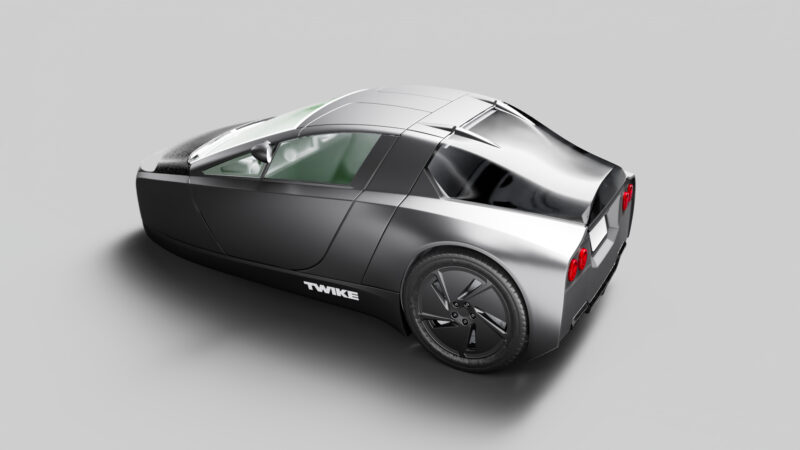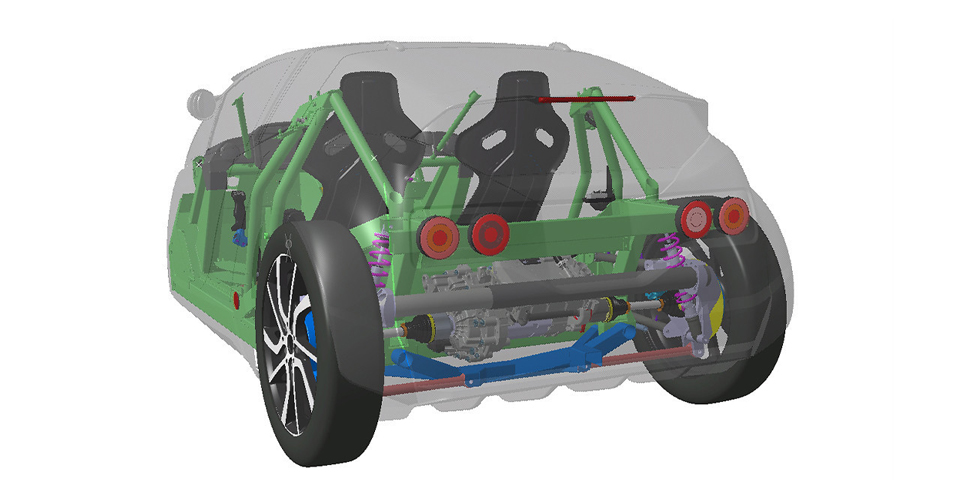
The bodyshell (body-in-white) of the TWIKE 5 is currently undergoing its foreseeable final development loop before it finally finds its way from the developers’ CAD programs to the prototype workshop in load-path and weight-optimized sheet metal shell construction. One positive aspect that stood out was that the chosen construction method allows for relatively uncomplicated modifications. The accompanying simulation calculations also show that further improvements can be achieved in terms of weight, costs and rigidity.
Neben allen Vorteilen bringt sich aber auch die 80/20er Pareto-regel in Erinnerung: Denn die weiteren 20% Verbesserung sind zwar deutlich spürbar, aber die verbundenen Mühen eben auch aufreibend zeitintensiv. Zu unserer Entlastung müssen wir feststellen, dass die Überarbeitung weniger aus reinem Optimierungsstreben getrieben wurde, sondern sie war notwendig, weil Änderungen aus der Aufhängung und der Positionierung des Motors dies erforderten. Denn die nun für die Serie festgelegte Antriebseinheit besitzt einen etwas anderen Formfaktor und dies verlangte eine Anpassung aller angrenzenden Bauteile (Position des Hinterachsrohrs, Antriebswellen, Anbindung und Art der Motorlager) und damit auch der alles verbindenden Rohbaukarosse.
Changing the position of the rear axle tube again required the mounting location of the chargers to be readjusted. As a result, the dimensions of the chargers also had to be adjusted slightly, which was achieved by beveling the edge of a side panel, which in retrospect seemed simple. Fortunately, the housing design of the charger was also in progress at this time, so that the corresponding modification was not critical in terms of time or cost. If there had been no available space under this charger housing wall, the rear design would have had to be redesigned. The associated change loops should not be listed here, we are simply grateful that the optimization could be completed so invisibly.
Adapting the frame concept took time, but allowed the weight and rigidity to be optimized once again. The assembly concept could also be further optimized in terms of time-saving work processes when installing and potentially removing the drive unit. The complete unit, consisting of motor, inverter, gearbox, drive shafts, wheel carrier, trailing arms, wishbones and the De-Pauly rear axle specially developed for the TWIKE 5, now sits as a sub-assembly on a sub-frame. This sub-frame carries the pre-assembled sub-assembly and closes the rear after assembly to the vehicle frame, making a decisive contribution to the rigidity of the overall structure. This now possible pre-assembly as a sub-assembly also helps to keep costs within the target window and promises to make the final assembly process more reliable.
The time-critical aspect for the start of production (SOP) is currently the frame that connects everything (body-in-white), which is why we have dedicated this news article to it.