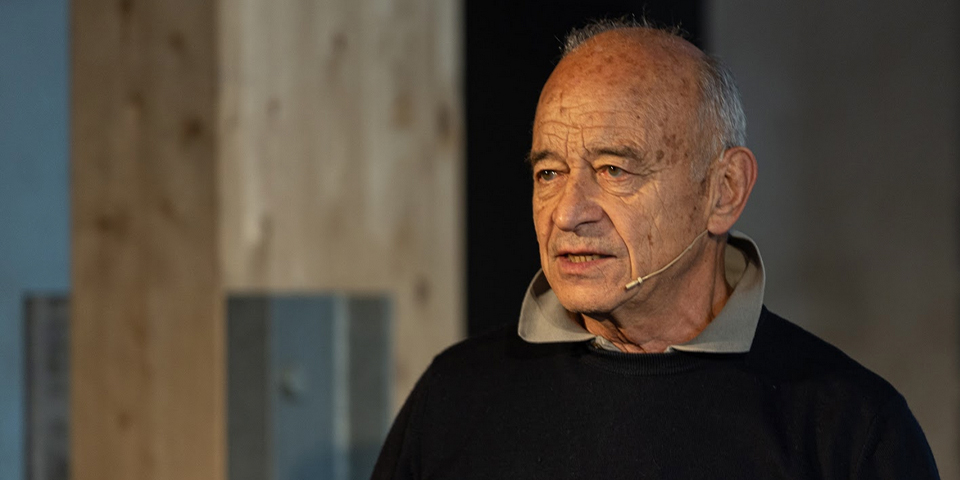
The name Axel Pauly is well known in the German automotive industry, especially when it comes to chassis design. He is not only one of the authors of the Handbook
Kraftfahrzeugtechnik (Automotive Engineering), a standard work published by Vieweg Verlag, and has himself worked in engineering education at the Technical University of Munich. Among other things, he worked for VW, most recently as technical director of their development company IAV, one of the world’s leading high-tech service providers to the automotive industry. At BMW, he was Head of Function Integration and Safety Control Systems, where he was involved in the development of superimposed steering, an active steering system in which the steering angle of the steered wheels is adjusted to the driving situation and speed by a mechatronic system.
Officially retired since 2008, Pauly continues to work as a freelance developer and also teaches. This is how he came into contact with TWIKE. During a series of lectures at the supplier Schaeffler, participants drew his attention to our vehicle manufacturer. “Martin Möscheid could use your expertise,” they said, according to Pauly.
Since a delta tricycle cannot support any rolling around the vehicle’s longitudinal axis via the front axle, the rear axle must perform additional functions compared to a four-wheeled vehicle: in addition to lateral guidance, it must also provide stabilization. The task was to combine these functions in the rear axle while controlling costs and (technical) ballast—an efficient solution was needed.
“It was an extremely exciting task for me; I felt a bit like I was traveling through time. Until the 1990s, the aim was simply to make cars better. After that, the focus increasingly shifted to making them more “attractive” and creating incentives to buy them. Models are becoming larger and wider, with technical assistants ensuring stability. says Pauly. With the TWIKE, the old claim of being extremely good, of being able to drive the vehicle safely and comfortably even at the limits, counts once again. “Driving dynamics, my hobbyhorse, took center stage again in the development of the TWIKE 5.”
“The idea was to build an axle with a constant camber angle that would not change even when the vehicle rolled. The solution was a hybrid between independent suspension and a rigid axle – this allows the vehicle to tilt without the wheel following the tilt. All other functions should be the same as with normal independent suspension.” The new development for TWIKE is called the camber-active rear axle and, in addition to the low center of gravity, ensures stability and lateral guidance.

Unlike most of the components used in the TWIKE 5, we cannot rely on standard parts. The wheel carrier is a specially manufactured aluminum casting. However, other components such as brakes and the axle tubes, which are important for lateral guidance, are standard components that are also used in large-scale production by other manufacturers. The requirements for efficiency and high driving dynamics were thus impressively met.