HMI stands for Human-Machine Interface. In short, it describes the user’s interface with the vehicle and offers unique opportunities.
HMI stands for Human Machine Interface. In short, it refers to the user’s interface with the vehicle, which requires special attention on the TWIKE 5 due to the integrated pedal system, but also offers unique opportunities. This is because the pedal system and the ergonomic seating position adapted to it with pronounced lumbar support enable extremely healthy sitting and, incidentally, fitness-enhancing exercise on everyday rides. The rider’s feet are always in contact with the pedals, which actuate the hydraulic brake when pedaling backwards. The transfer period for the change from the gas pedal to the brake pedal cannot be any shorter, there simply isn’t one.
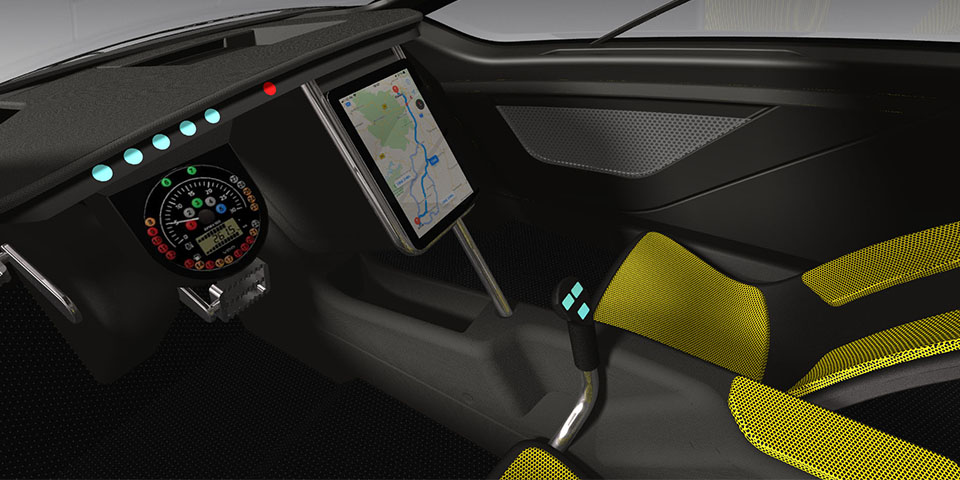
The round instrument located in the driver’s direct line of vision for displaying all legally required driving information, such as speed, high beam or indicator lights, is never obscured by a spoke on the steering wheel. These simply do not exist either. Instead, the TWIKE is controlled intuitively with 2 mechanically linked hand levers, the arm muscles know the movement sequence from the familiar steering wheel. The round instrument rests safely shaded under a dashboard, with the most important control buttons located close to this instrument.
Other additional instruments in the form of a smartphone or pad (so-called bring-in-devices), for example, can be easily attached to the center area of the dashboard or overhead on the center bar of the roll bar using commercially available holders. Overall, the HMI concept of the TWIKE 5 is as reduced as possible, but offers the opportunity to combine individual and up-to-date devices for additional functions (navigation, multimedia, camera, …). However, the basic equipment is already sufficient for everyday needs (charging status, speed, high beam, indicators, etc.).