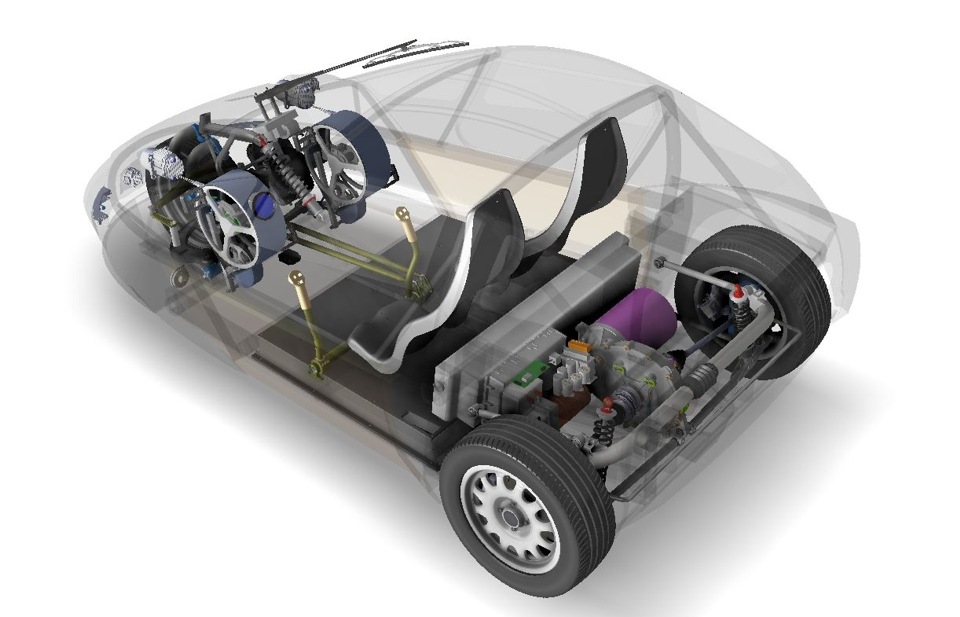
After the vehicle assemblies such as the drive and chassis of the TWIKE 5 have already been presented, here is an insight into the development of the on-board electrics and electronics.
In his master’s thesis, TWIKE employee Adrien is working on the integration of modern human-machine interfaces (HMI), the interfaces between the vehicle electronics and the user’s input and output options. The overall package developed is so universal that it can be used as a central element for entertainment and data communication for the upcoming TWIKE 5 and also as an extension for the existing TWIKE 3.
The basis is a freely programmable microcomputer called Raspberry Pi, whose hardware can be set up and expanded as required in order to respond to a wide variety of requirements. The data of the older RS485 bus system of the TWIKE 3 as well as the CAN bus information of the TWIKE 5 can be read out with this system and displayed in any form or used for further evaluations and calculations. The image shows the progression of energy consumption and the distance traveled, which were recorded during a test drive with the TWIKE 3 and can be used , for example, for display on a mobile device. A prototype app for smartphones already exists for this purpose, which communicates with the vehicle via WLAN and opens up a wide range of other possibilities.