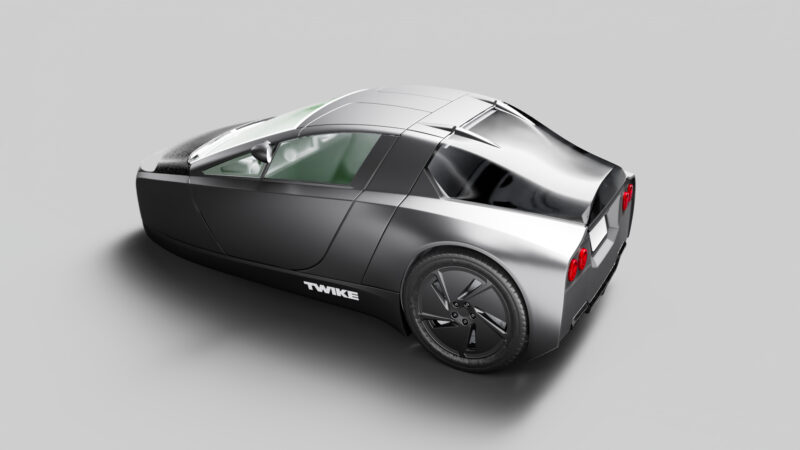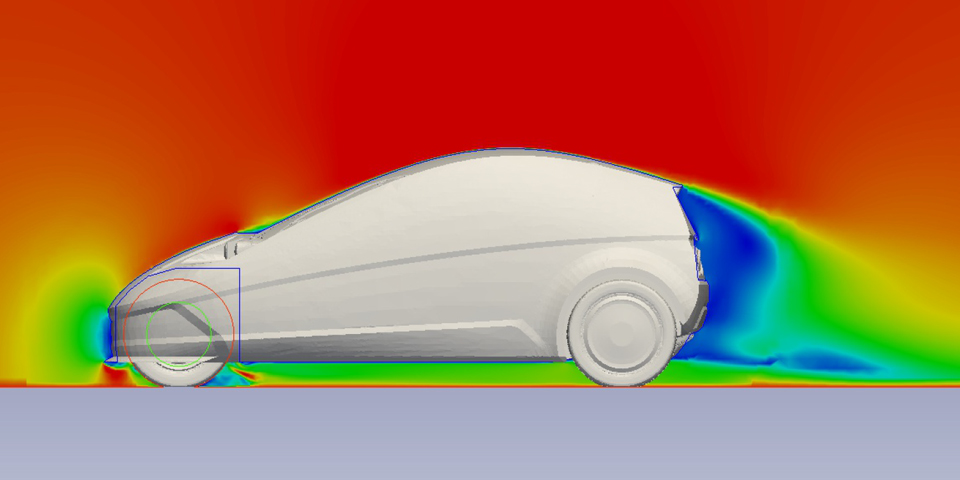
Actually, the surface of the roll bar and the windscreen frame were considered to be set and we assumed only delicate detail optimizations in the front and rear areas of the outer body to achieve the targeted “better than 0.25” for the cw value, the so-called drag coefficient of the TWIKE 5. Admittedly, with its relatively short length of 3.15 m, the vehicle body is more in line with short city vehicles, which generally have a drag coefficient of around 0.35. Also, on such a short vehicle length, a 1.54 m wide body cannot be pulled together at the rear like a VW XL1, for example. But this also has a cw of 0.19 and in our first simulation calculation for the TWIKE 5 we still clearly have a 3 after the decimal point. And that’s a no-go.
In order to avoid having to rework too much of the development work that has been done, which could lead to more extensive and in-depth packaging loops, we now need to redesign and optimize the surface until we have achieved a cd of 0.25 or better. This also has an impact on the roll bar, which should actually be derived from the exhibit shown at the Geneva Motor Show. The shape and size will foreseeably change minimally, which will probably hardly be noticeable to the eye, but would rule out the present body for target-oriented preliminary tests.
Overall, we are dissatisfied ourselves, especially with the resulting delay in all work, which certainly amounted to 8 weeks. In order to avoid further delays, external development partners were therefore commissioned, which initially means more time expenditure, but which will pay off in higher development speed and quality. The next blog entry will report on the contribution of the development partners and the progress of the cw value.
Update from November 15, 2019: After an initial revision of the body surface, a cw value of less than 0.27 has already been achieved with a more recent calculation. We are now quite certain that we will be able to reduce the value significantly in further loops.