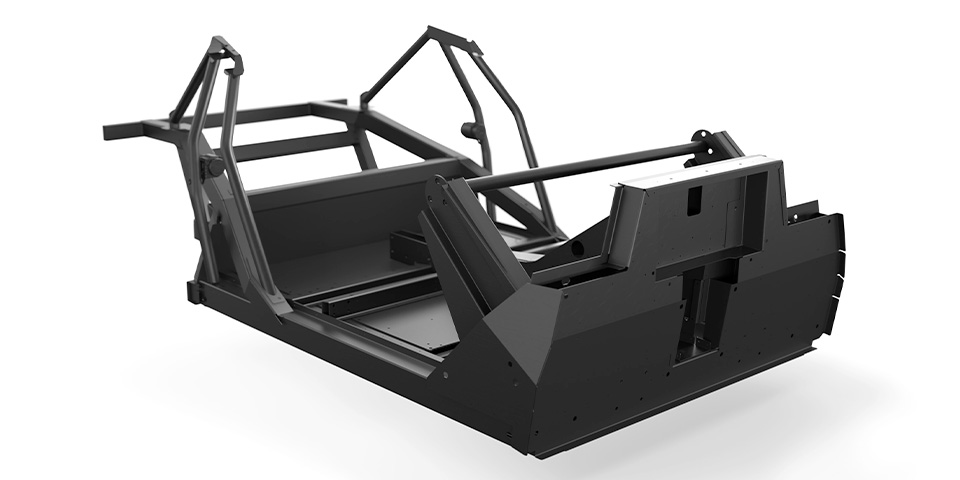
The first sample of a TWIKE 5 frame was built in the last few days. The individual parts of the sheet metal shell construction were initially joined with screws, providing an opportunity for final optimization. In series production, the aluminum sheet metal shells are bonded over their entire surface, which will significantly increase the strength of the overall construction compared to a purely bolted design. This makes the already noticeable rigidity all the more impressive, even taking into account the low weight of the assembly, which currently weighs around 52 kg.
The frame is only the answer to the parts mounted on it and the forces acting on them. It carries and protects the passengers and their luggage in the interior. It absorbs the forces transmitted from the suspension arms and transfers the weight to the suspension strut mounts. The rear-wheel drive pushes the acceleration forces into the frame via the rear trailing arms. In the event of braking or recuperation, it pulls on the trailing arms, as it were. In contrast to pure braking, the engine braking torque applied via the drive bearing is superimposed during recuperation. In the event of an accident, structural components are deliberately deformed and thus dissipate defined crash energy. The fact that the battery could be completely connected as an additional sandwich between the side members of the body not only reduces the height of the center of gravity, but also significantly increases the bending and torsional rigidity of the frame.
In addition to structural rigidity, the chosen shell design in aluminum sheet meets other required properties in terms of a high degree of lightweight construction, excellent recyclability at the end of use and low initial investment costs for tools. Aluminum sheets and the holes required in them are laser-cut to size with high precision, folded with a high degree of automation and then fixed, glued and riveted in holding tools. The rivet ensures that the joint fits precisely and holds the bonded surface in the desired position during the curing process.
The fact that local increases in rigidity can be achieved without adapting a tool, e.g. by adjusting the sheet thickness, is advantageous in terms of development. Whether and where this will be necessary will be shown by the experience gained from the further construction and the feedback from the driver testing. We will report more on the further construction in a subsequent article.