Uff, das war anstrengender als erwartet.
The concept phase cost us a lot of energy and took a little longer than we initially allowed ourselves. However, the result is impressive and we are proud of what we have already achieved as well as of the good cooperation between the entire development team and the support of the supplier companies. Once again, we were shown the critical limits of such a development concept in all areas and became painfully aware of the complexity of vehicle development. This is because every detail, every decision on a component, a choice of material or a dimensioning is necessarily linked to the adjacent component or the requirement for the assembly in question. And all decisions as a whole are influenced by a matrix of boundary conditions, be it requirements regarding weight, manufacturability, availability, recyclability, costs or approval conditions, to name but a few. It’s not actually complicated, but it is very complex.
Seemingly small changes or simple adjustments to a geometry suddenly lead to time-consuming development loops because a supposedly simple purchased part will not be available to us in the required version in the foreseeable future. This in turn results in a new search for a suitable component that can ensure suitability and availability. At the same time, it means obtaining CAD data, scanning and converting it back into data that can be read by the CAD system and adapting the development again at this point. Finally, this has to be coordinated with the adjacent surfaces or components. In a good team and under time pressure, this also produces gray hair, but we have been able to achieve very good results in the last three months. And with these, we are now going into series development.
Although initial simulations were already carried out in the concept phase and these provided valuable information on critical load paths for the frame structure, the time has now come for the calculators once again. The CAD data of the body shell created in the concept phase is checked for plausibility and discontinuity, meshed and subjected to forces known from typical crash cases as well as known driving load cases, thus ensuring its suitability. Knowing that there is no social acceptance of absolute safety in an automobile,
CAE (Computer Aided Engineering) tools enable the best possible tools for optimizing vehicles with regard to their protective function and associated dimensions and the resulting weight.
The calculation results then flow back to the design department in several rounds, which adapts the design taking into account the targeted total weight and the target center of gravity and modifies it until an optimal result can be confirmed. At the same time, the production processes are planned in more detail, the material flow is defined, the space required for the production processes is determined, the purchasing conditions and delivery lot sizes are agreed in initial contracts, the qualifications of the employees working in production are determined and the logistical process for incoming materials and vehicle provision is planned. The approval procedure is also prepared with the collection of initial documentation of the components worthy of testing and the comparison of the documentation with the statutory approval requirements. These have become much stricter in recent years, which causes considerable additional work for the documentation and in some cases also drives up component prices, as more stringently formulated requirements have to be met on the supplier side. Not actually complicated, but very complex.
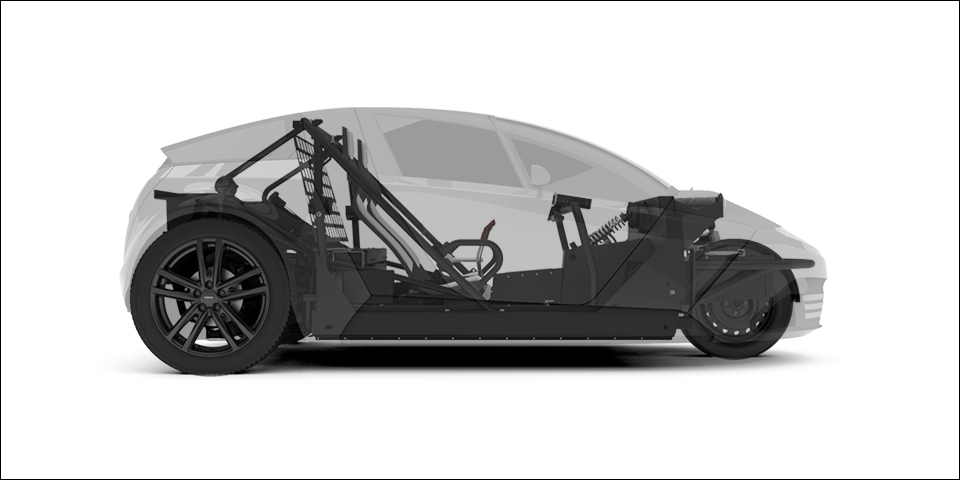
The illustration shows an X-ray view of the current design status. The dark frame structure will be manufactured over the next few weeks and, together with all the components relevant to driving, will be assembled into the driver test carrier (FET). The drive components and all components of the EE architecture relevant to the FET are being worked on in parallel and the anticipation of the first test drive is already making our hearts beat faster.
Updates will follow.