At first glance, riding on three wheels does not seem as stable as riding on four. However, there was one main reason why we at TWIKE decided to design a three-wheeled vehicle: significant weight reduction and, as a result, greater energy efficiency. By addressing the weak points of the three-wheeler—lower stability due to a smaller contact area—and implementing appropriate compensatory measures, we were even able to enhance the lightweight construction and driving dynamics potential without any disadvantages for the user. But that’s not all when it comes to safety.
First things first: the TWIKE is not a car, so the safety of our tricycle cannot be compared to that of a car. As the number of wheels suggests, the TWIKE is a vehicle that falls between a motorcycle and a car. The requirements applicable to the EU vehicle class L5e, which is relevant for fast three-wheelers, are generally less extensive than those for passenger car registration classes. This also means that the safety requirements are lower. Nevertheless, the well-being of our drivers and passengers is very important to us. We have therefore taken a number of measures to optimize active and passive safety for the TWIKE.
Eins vorab: Das TWIKE ist kein PKW und entsprechend lässt sich die Sicherheit unseres Dreirads nicht mit der in einem Auto vergleichen. Wie die Zahl der Räder schon andeutet, bewegt sich das TWIKE als Fahrzeug zwischen Motorrad und Auto. Die für ein schnelles Dreirad relevante EU-Fahrzeugklasse L5e gültigen Anforderungen sind grundsätzlich weniger umfangreich als die der PKW-Zulassungsklasse. Das bedeutet auch, dass die Auflagen in Sachen Sicherheit niedriger sind. Dennoch liegt uns das Wohlbefinden unserer Fahrerinnen und Fahrer sowie der Mitreisenden sehr am Herzen. Und so haben wir für das TWIKE einiges unternommen, um die aktive und passive Sicherheit zu optimieren.
Active safety through chassis
Key factors for stability are the position of the center of gravity and the reaction of the chassis. We have placed the center of gravity very low and far to the rear. This means that the TWIKE 5 can be ridden safely through demanding maneuvers even at high speeds. The suspension was developed in collaboration with an experienced suspension specialist and already has a noticeably high reserve in terms of lateral dynamics in the TWIKE 4 concept vehicle. As a result, it offers an impressively safe, agile and yet comfortable driving experience. Braking is mainly achieved by so-called recuperation, which is controlled by a finger rocker. Experienced riders can bring the TWIKE to a halt at the touch of a finger. In extreme situations or when stopping at a junction, a powerful coaster brake is also used.
Alu-Space-Frame – Modular safety cell for passive safety
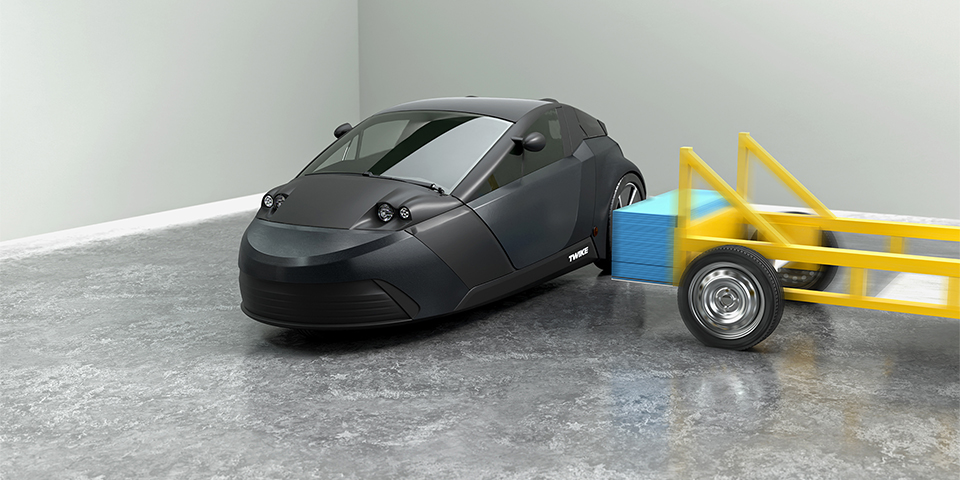
The lightweight, crash-optimized vehicle frame made of bonded and riveted aluminum sheet shells, cast nodes, and extruded profiles in combination with fiber composite structural components was developed in cooperation with an experienced development service provider from the automotive industry. A three-point seat belt safety system is integrated into the frame structure. Common crash scenarios (roof crushing, pole, front, and side impacts) were digitally simulated and the frame structure was optimized accordingly.
TWIKE drivers and passengers are therefore not only sustainably mobile and protected against all weather conditions. They can also travel with peace of mind in general traffic in terms of driving safety.
TWIKE Piloten und Passagiere sind somit nicht nur nachhaltig mobil und gegen jede Witterung geschützt. Sie können sich auch im allgemeinen Verkehrsgetümmel bezüglich der Fahrsicherheit mit gutem Gewissen bewegen.