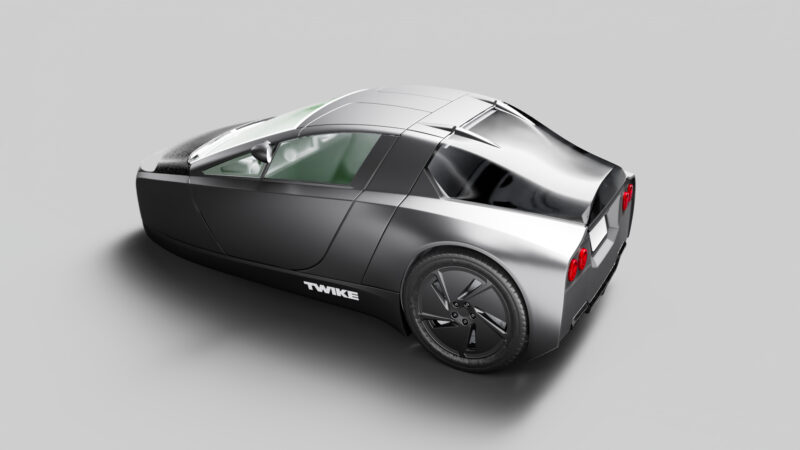
The development of the TWIKE began with the vision of a vehicle that would enable mobility completely without fossil fuels. This was long before Tesla and the renaissance of the electric drive in the automotive industry. The developers of the TWIKE were way ahead of their time. Today, when the departure from the combustion engine is seen as a significant contribution to the mobility transition, we know that e-mobility does not necessarily mean uncompromising sustainability. TWIKE is completely different. Careful use of resources is an important aspect, not only for transportation, but also for production. The construction of our company headquarters is a good example of how we take this philosophy into account and implement it in our day-to-day business.
When we brought the production of the TWIKE from Switzerland to Germany in 2002, we took this as an opportunity to reorganize our company headquarters. Due to the increased demand, we needed a larger production area and more storage space at our site in Rosenthal, Hesse. The tranquil little town is centrally located between Giessen and Kassel and is only about an hour away from Frankfurt Airport. This is where the headquarters will be located in the future and where the TWIKE 3 will be fully manufactured.
A company headquarters that reflects our vision
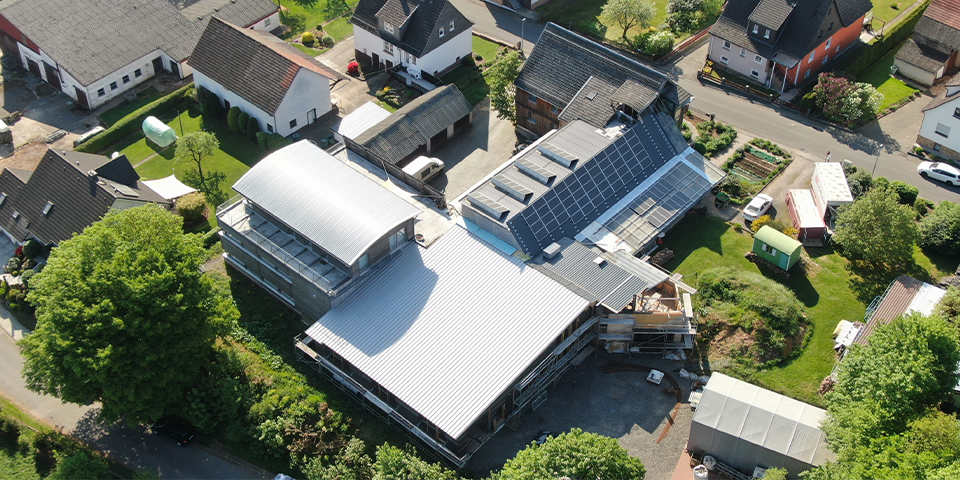
When it came to planning the new company headquarters, we quickly realized that our vision of a sustainable future should also be taken into account. We therefore decided to turn an existing old barn from a former farm into our headquarters. We discarded our initial plan for an energy-efficient renovation and instead built the barn from scratch. This allowed us to ensure that all aspects of the construction were sustainable.
We opted for a rather unusual approach for the foundations. We wanted to use as little concrete as possible, as its production generates high CO2 emissions. Our foundation consists of foam glass gravel made from recycled glass. It is load-bearing, can be compacted well and also has the positive property that it insulates the house well from below.
Passive house with photovoltaics and pellet stove
For the rest of the construction, we opted for a timber frame construction. The 46-centimetre-thick walls are insulated with Isofloc, an ecological insulation material based on cellulose. This is complemented by clay plastering, which ensures breathable walls and prevents moisture from accumulating. The façade was hung on wooden nails so that heat transfer is reduced to thin wooden pins. The south side is glazed, which allows us to use the sun to warm the house in winter. At the same time, the house is shaded enough to prevent it from heating up too much in summer.
Our company headquarters is a passive house and therefore meets the criterion that we use no more than 15 kilowatt hours of energy per square meter per year, which corresponds to energy efficiency class A. On particularly cold winter days, additional heating can be provided by a wood pellet stove. We generate electrical energy using photovoltaics, which means that we currently produce four times more electricity than we consume for our production processes. As soon as production of the TWIKE 5 starts, we want to increase our current solar production even further.
The TWIKE headquarters in Rosenthal thus embodies our endeavor to make the most of the opportunities available today along the entire value chain for people and the environment.