Is the TWIKE 5 really more efficient in everyday use than the TWIKE 3, even though the new drive will have more than 10 times the power and significantly more torque?
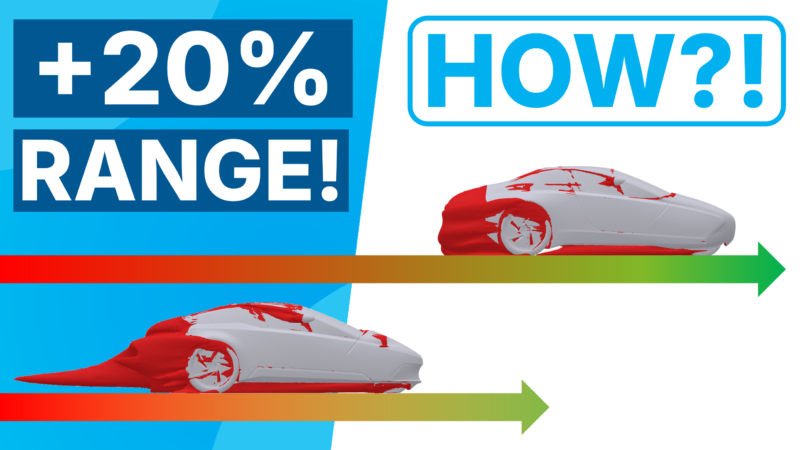
The fact that aerodynamics have a decisive influence, especially in the upper speed range, has already been highlighted in previous reports and will accompany our developers until the start of series production. However, the higher efficiency of the synchronous drive and the more modern power electronics play a major role in this lower consumption. We will take a closer look at this new drive system of the TWIKE 5 in a later article.
The following lines will show how the interaction of all optimized properties and components will affect a possible extreme use. In addition to the usual daily commute to work, this could be a vacation trip, for example, with the aim of covering the longest possible distance in the shortest possible time. High-profile events such as the e-Cannonball, for example, set their participants the task of covering such long distances with the shortest possible charging stops in the shortest possible time.
OSCHERSLEBEN RACETRACK ecoGP
The ecoGP requires participants to complete as many laps as possible within 24 hours, not only on public roads but also on closed-off circuits. A course that is the same for all participants on a closed circuit and a strict set of rules, e.g. drivers must take a break after a maximum of 4 hours driving time, practically force a participating racing team to change drivers, bring a high level of safety to the race and also allow the mathematical simulation of an expected race result. At least in theory. In practice, none of the mostly non-professional drivers will be able to complete such consistent laps over 4 hours of driving time as the legendary racing driver Toni Mang did in his day. Nevertheless, the simulation provides important information for an optimal riding strategy. And the results of this simulation already look extremely promising for a TWIKE 5:
TWIKE 5: 200 ROUNDS MORE
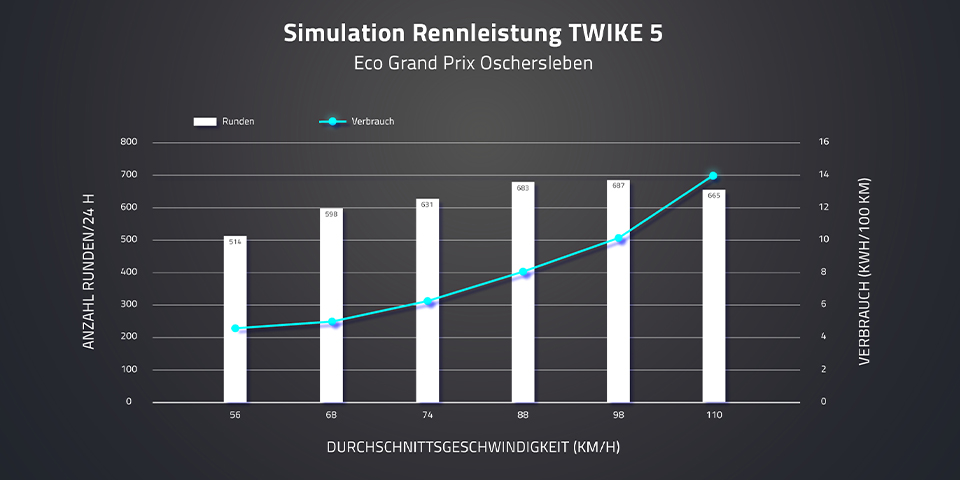
While the TWIKE Gerbil team was ableto take 8th place with the TWIKE 3 during the Germany 24 Hours 2018 in Oschersleben with 443 laps completed (ahead of Jutta Kleinschmidt on BMW i3s, 439 laps), the TWIKE 5 could even complete around 200 more laps under optimal conditions (see image above).
The TWIKE 3 already has good prerequisites for this special discipline of the ecoGP: The fuel consumption is low and the top speed is slightly above the average speed to be targeted. The maximum charging power of 22 kW prescribed by the regulations was provided during the race using an external charger. However, the TWIKE 3 was negatively affected by the fact that the speed had to be reduced in the bends and subsequent acceleration processes used up valuable energy.
TWIKE 5: 5,3 KWH/100 KM
The TWIKE 5 would manage a significantly higher number of laps because the improved aerodynamics and the better electrical efficiency of the drive and integrated charging system would bring decisive fuel consumption benefits, especially in the speed range above 60 km/h. But the high driving stability, which is equivalent to that of a sporty car, would also allow smoother driving through bends and greater efficiency due to the lower speed fluctuations. If a relaxed average speed of 56 km/h were targeted, a consumption of around only 5.3 kWh/100 km could be expected (the TWIKE 3 required around 7 kWh/100 km at a lower speed). Every 10 km/h faster would increase the number of laps and thus the maximum driving distance within the 24-hour race, but unfortunately also the consumption and thus the time at the 22 kW charging connection.
TWIKE 5 AT OSCHERSLEBEN RACETRACK: 1.585 KM IN 24 HOURS
If the prescribed driver change and one uncounted lap for each pit stop are also taken into account, the maximum number of laps achievable in the simulation is 651 with a correspondingly rated distance of 1,585 km. Considering the limited charging power of 22 kW, we find this value sensational!