With the TWIKE Challenge 1998, a group led by Francois Loeb, a9> Swiss National Council member Francois Loeb – 25 years – first TWIKE pilots on a17> a over 70-day tour to North Cape.
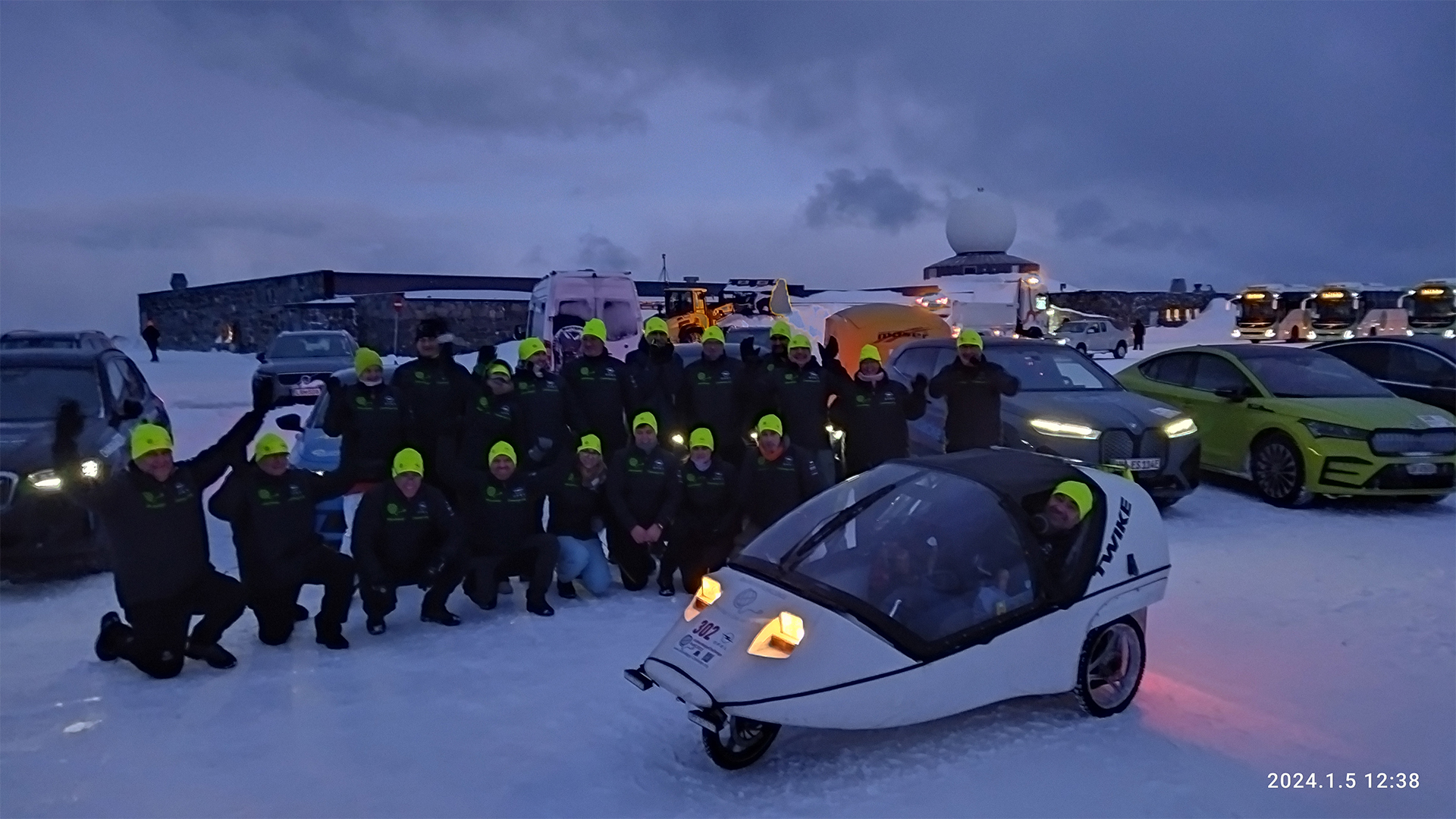
To honor this magnificent achievement, a TWIKE was once again present at this year’s eNordkappChallenge 2023 (#eNC23) organized by Peer Haupt: the TW204 with Swiss TWIKE pilots Adrian and Hans.
The eNC23 officially started on December 27, 2023, in Schleswig-Holstein and ended on January 5, 2024, at the North Cape. The individual teams began their journey from their homes and crossed Germany, Denmark, and Norway via the Lofoten Islands to the North Cape.
Markus Gwerder, himself a TWIKE 3 pilot, was in close contact with the Swiss team Adrian and Hans and followed the challenge for TWIKE, gaining valuable insights and documenting them for us.
In the following article you will find excerpts from the travel report and exciting background information about the team, the motivation for this special undertaking and how the journey to North Cape went is. The two reached the North Cape on January 5, 2024.
An exciting question that certainly some people are asking themselves: How did someone ever come up with the idea to drive a TWIKE 3 to the North Cape in winter?
Hans and Adrian from TWIKE Team 302 were able to buy a damaged TWIKE at a bargain price. All they needed was a project – the two have been driving various electric vehicles since the 1990s. They know the scene, so it was obvious that they would take part in the eNordkappChallenge 2023. It wasn’t a bet they had to settle. It was an adventure for which Hans and Adrian were well prepared. They have experience, having already made several unusual trips to places that are not so easy to reach by bicycle. This has taught Hans and Adrian to respond creatively to situations. It was important to them to reach their fixed points, such as ferries and daily destinations.
On December 27, 2023, the eNordkappChallenge finally started near Flensburg. From there Adrian and Hans drove through all of a13> Denmark heading north to take the ferry to Gothenburg across the water. On the second day, we continued on to Oslo, unfortunately suffered the TW204 there an engine failure. “The engine failure was caused by overheating on the highway .” Due to the shortly before departure still replaced electronics was me not clear to me that we had no temperature warning. It was yes rather cold and there I didn’t a60> didn’t even think about the engine overheating at all.” said Adrian about the unfortunate circumstance.
“Many thanks to TWIKE for providing us with a replacement motor so quickly. A friend transported it in his Tesla. Thanks to the support of all the teams and the tools they had with them, we were able to install the motor in an underground car park. I don’t think any of the other vehicles that took part in the challenge will still be running in 25 years’ time, let alone get a replacement motor.” Adrian added.
After the repair in the Lofoten Islands, to which the TWIKE was transported in a trailer, the TW204 pilots once again set off on their own axle towards Alta. The joy was great, because from that moment on they could a27> enjoy beautiful moments and take great pictures of the a34> TWIKE in the wintery Lofoten Islands.

“We still have cold feet. The cold is a big problem. When we pedal to stay warm, the windows fog up and you start sweating, which makes you feel even colder afterwards. When we drive into a cold lake, it snows inside the TWIKE (the moist air condenses and turns into snow).” reported Adrian Markus Gwerder on January 6, 2024.
“The stages were too long for the TWIKE. If we wanted to stay in the race, we had to load it up in certain situations (engine failure, and later at the North Cape). It was extremely cold, with snowfall and wind. That’s not a good situation for a TWIKE. You would have to wait for better conditions, but that’s not possible in this challenge. Since the weather forecast for the weekend was very bad, we decided to drive directly from Alta to the North Cape,” Adrian continued. “We had to be at the last barrier at 11 o’clock. At the first charging stop after Alta, I had a a14> cable not plugged in and only after 50 minutes noticed that it was not charging. We then drove to the a28> next charging point and wanted to recharge there. But there were only DC chargers available, none of type 2. The same at the next charging point. It seems that here in the north of Norway all with DC charging. There are only still DC charging stations in operation.”
Adrian continued: “We had already on Thursday because of the a5> cold weather no display in the TWIKE display. On Friday then the display a14> display again, but the range indicator showed only 20 km, even though the voltage was fully charged according to the measurement. Adrian suspects that the controller somehow does not correctly balance the charge. The TWIKE was then loaded onto the trailer so that they could at 11 o’clock at the barrier to the North Cape were. Due to the cold weather, a small crack in the TWIKE’s shell, which had been there since the accident, has grown so large that it needs to be repaired before we can continue our journey. The weather forecast for the next few days is not ideal. Driving the TWIKE back slowly would mean a long wait and repairs. We’re not going to do that in this cold weather. The trailer has to go back to Switzerland anyway. Team 305 is taking it to Hamburg. So we have decided that the TWIKE will travel to Hamburg in the trailer and Hans and I will return with Herbert in the TTT – TWIKE Team Tesla Taxi. We won’t be spending the night in the Tesla, but in accommodation instead.
Adrian had positive things to say about fuel consumption: “The TWIKE’s average fuel consumption was probably around 65Wh/km, which corresponds to approximately 6-7 kWh/100 km. That is much less than the average consumption of the other vehicles.”
In the run-up to and during the eNordkapp Challenge, large charging stations for electric cars with tens of kilowatts of power are a recurring topic. Today, you can quickly drive from Bern to Hamburg and back. Accompanied by the e-community, recommendations are made on where to find the best charging power at the lowest price and how quickly the batteries can be charged. Is this everyday practicality or a love of technology?

The TWIKE 3 cannot compete with this. In everyday life, cars are mostly “stationary vehicles” and are only driven an average of 40-50 km per day. For everyday use, there is no need for such large vehicles with huge batteries and charging capacities of tens of kW; small vehicles can score points here – just like the TWIKE! In everyday life, it should be possible to charge the car at a normal power outlet in the parking lot using solar power; a wall box is not absolutely necessary for this. However, this infrastructure is still largely lacking.
Everyday practicality is irrelevant on a two-week trip to the North Cape – this is an exceptional situation! Twenty-five years ago, TWIKEs had a range of around 80 kilometers during their North Cape Challenge and were charged using normal power outlets. Back then, the route did not take them directly to their destination via highways, but was part of the adventure itself: with a TWIKE, you can enjoy sporty trips along beautiful landscapes and through villages full of surprises – pure enjoyment! Traveling means going on a journey of discovery, broadening your horizons, and experiencing adventure. Traveling with the TWIKE is not just about clocking up miles.
Everyday practicality begins in the mind – our vehicles do not have to be suitable for exceptional circumstances – we should purchase vehicles that are appropriate for our usage, rethink our mobility needs, and protect our environment through our actions.