Historical Development Status – Post from January 23, 2021
The figure of under 3.8 seconds mentioned in this post is based on simulations from the development phase at that time. The currently reported figure of approximately 4 seconds from 0 to 100 km/h is also a target value from vehicle development and not yet a final, measured production figure. With today’s announcement, we are deliberately taking a slightly more conservative approach. The final performance figures will be validated using a production-ready vehicle.
With its electric powertrain, the TWIKE 5 can accelerate from 0 to 100 km/h in less than 3.8 seconds. This figure is provided by a simulation tool primarily used to estimate expected fuel consumption.
But does an electric vehicle—already optimized for the lowest possible energy consumption of less than 7 kWh/100 km—really need to demonstrate such brutal acceleration? A similar question arose when the top speed of 190 km/h was announced—a speed that, as a permissible driving speed, seems—and indeed is—completely outdated.
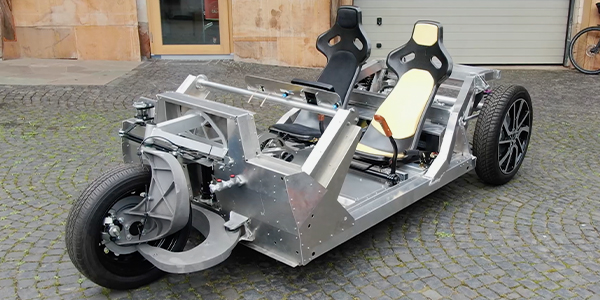
So why such a performance-oriented design for this three-wheeled vehicle concept, which was initially perceived as somewhat unstable? And that is precisely the motivation behind this balancing act. After all, the TWIKE 4 itself serves as a “proof of concept,” demonstrating the performance capabilities of the innovative axle design, which has been further optimized in detail in the TWIKE 5.
Now, not everything has to be implemented just because it’s feasible. And the exact acceleration figure that ultimately makes it into production isn’t yet determined by the theoretical possibility alone. But by combining all these characteristics (lightweight, aerodynamic, high electrical efficiency, agile and safe driving dynamics)—and thereby spark interest in practical lightweight electric vehicles—will, from a marketing perspective, take a stand for the entire industry in the spirit of its Swiss forebear.
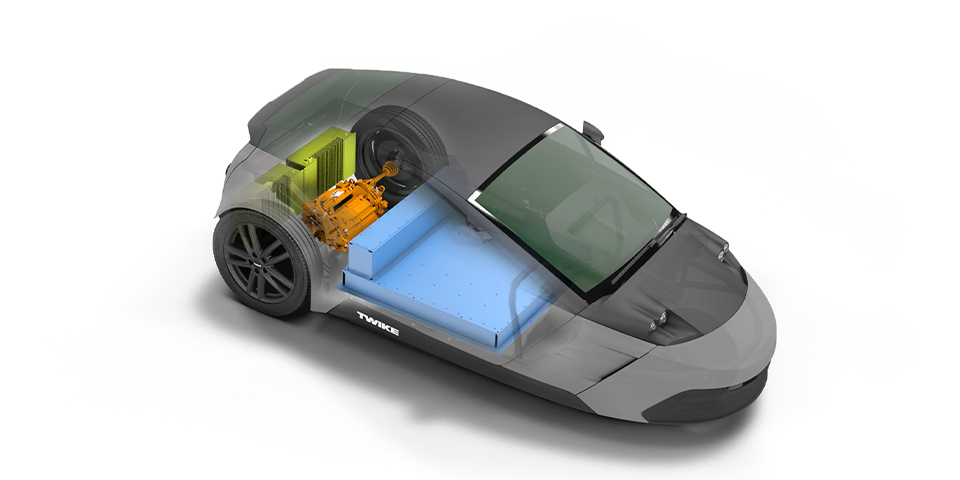
The tangible benefits for customers will be evident in consistently powerful acceleration and a robust, long-lasting design—all made possible by the powertrain’s substantial thermal reserves. Any attempt to push the system to its limits will result in tire wear, as the tires will deliberately be the weakest link in this drivetrain, which transmits up to approximately 1,800 Nm.
Being able to tap into that deep reservoir of torque when needed will be a major part of the driving pleasure—in addition to the practical benefits of its ingeniously low fuel consumption and the opportunity to stay physically fit while traveling. In our estimation, the TWIKE Pilot won’t want to measure acceleration. He just wants to have enough of it.