Historical development status – article from August 5, 2015
This article documents an earlier stage in the development of the TWIKE 5. Technical specifications, efficiency figures and vehicle parameters may no longer reflect the current development status. You can find the latest technical specifications on the TWIKE 5 page.
Compared to the TWIKE 3, the TWIKE 5 will gain a lot in terms of riding safety, comfort and dynamics. Nevertheless, it is a matter close to our hearts not to fall into the typical “bigger-faster-heavier-consumption-intensive trap”.
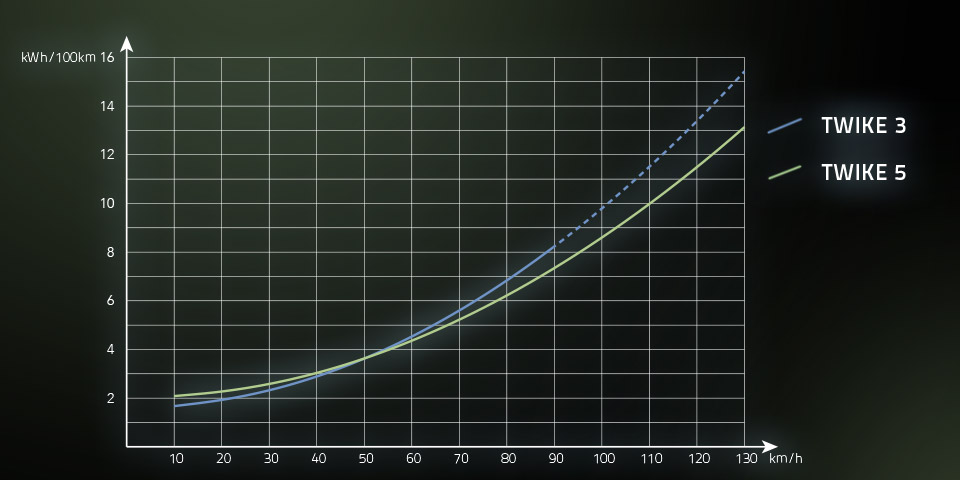
For this reason, we optimize every component of the vehicle in order to be able to compete with our extremely fuel-efficient TWIKE 3. The diagram illustrates the key to success: at low speeds, the TWIKE 3 makes the most of its unrivaled light vehicle weight; the resulting rolling resistance leads to minimal energy consumption. As soon as speeds increase, however, other effects dominate: The TWIKE 5 benefits from its even better aerodynamics and the higher efficiency of the electric system, resulting in a significant consumption advantage at constant speeds of around 50 km/h and above.
In a nutshell: The TWIKE 5 would complete our recently set range record of 613 km with the largest battery configuration at an average speed around 20% higher. The – ultimately decisive – energy balance from the mains also improves thanks to the higher efficiency when charging.
What is the consumption in kWh/100km for the TWIKE 5?
According to current planning, the theoretical consumption of the TWIKE 5 at a constant speed of 100km/h is around 7.3kWh/100km.
What are the reasons for the efficiency of the TWIKE 5?
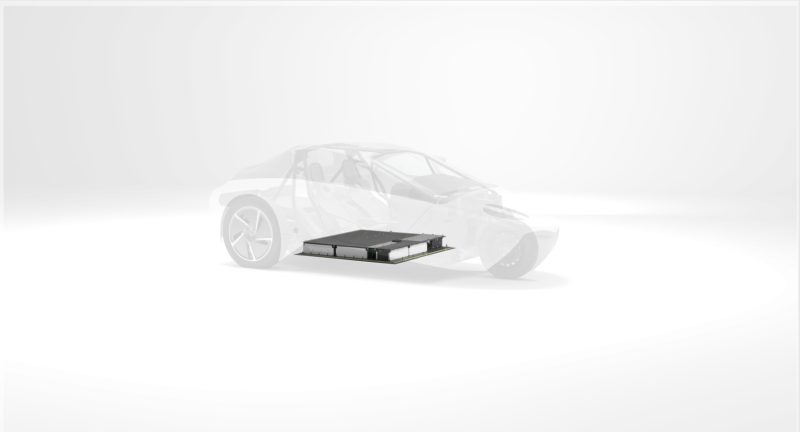
The low energy consumption of the TWIKE 5 results from the low vehicle weight of less than 500 kg, the low cw (0.24) and a small frontal area (1.7 m^2). The high efficiency of the synchronous drive and a modern inverter also contribute significantly. The Lion battery, with a nominal voltage of 350V, also has extremely high efficiency and virtually no thermal losses. All this adds up to WLTP consumption of around 7.3 kWh/100km and the aforementioned figure of around 6 kWh/100km when driving at a constant speed of 80 km/h.